
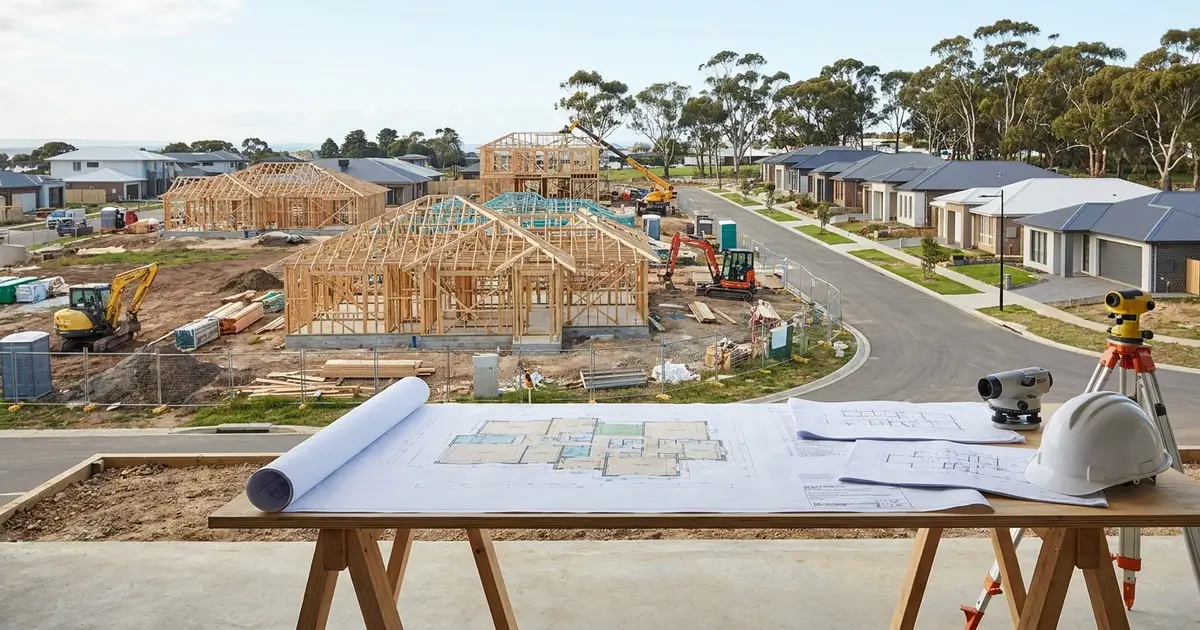
A construction ERP is a single system that holds the job and the ledger together. Accounting software records what already happened. An ERP holds what is happening to each job, while you can act on it.
That sounds academic until you are assembling a progress claim by hand. Then it is the difference between knowing a job's margin at practical completion and knowing it in month two. Most builders reading this are on Xero or MYOB. This guide covers where the ledger stops and an ERP begins, the signals that you have crossed the line, and what implementation costs.
Key Takeaways
- Accounting software is the system of record for the entity; a construction ERP is the system of record for the job.
- No published revenue figure marks where an ERP becomes correct. The signals are structural: multi-entity books, subcontract-heavy delivery, retention, invisible committed cost.
- Australian construction ERP pricing is mostly quote only. Premier (Jonas) publishes list prices; Access Coins Evo, Jobpac Connect, Procore and Sage Intacct do not (checked October 2026).
- Progress claims and retention are contract mechanics under AS 4000 and AS 2124 plus state Security of Payment Acts. Software treating a claim as an invoice will not hold retention.
- Implementation is a project with its own budget, and on mid-market platforms the fee often exceeds the first year of licence.
What a Construction ERP Is, and What It Is Not
An ERP is the system of record for the job. Accounting software is the system of record for the entity. Those are different jobs, and conflating them is where the money goes.
A ledger must be complete for statutory purposes. It has no obligation to tell you what a job cost. In construction those requirements diverge, because every job is a new cost structure and the question that matters is not what you spent but what this job will finish at. The ledger holds the transaction and its tax treatment, not cost code granularity, a purchase order committed against a budget before any invoice exists, or retention withheld for a defined release trigger. Sub-ledger architectures are legitimate: a common Australian pattern is a construction platform for claims and subcontractors, with Xero or MYOB retained at each entity as the statutory ledger behind an integration layer.
| Category | What it holds as truth | What it does not hold |
|---|---|---|
| Accounting software (Xero, MYOB) | The entity's transactions: GST, BAS, payroll, statutory accounts | Cost code depth, committed-but-not-invoiced cost, contract position, retention exposure |
| Project management software (Procore, Aconex) | The programme, documents, RFIs, site records, quality | The general ledger, the contract sum, statutory reporting |
| Construction ERP | Both: cost codes, contract position, commitments, claims and retention, feeding the ledger | Nothing by design. It is meant to be the single record |
Four capabilities separate an ERP from an accounting package: job costing to cost code level with committed, actual and forecast-to-complete; claims, variations and retention modelled as contract objects; subcontractor administration including TPAR payment data; and multi-entity consolidation. Need three and you are in the market; need one and you likely are not.
Every report you will ever run is a query against the cost code structure. A structure that works for a mid-tier builder has four levels: entity, project, cost centre or package, and cost code, with the head contract above the project and each subcontract alongside its cost centre. Code to the level you actually manage at, not the level a demo shows. Our guide to construction cost management software covers committed versus actual and forecast to complete.
The Threshold Question: Do You Actually Need One?
No published revenue figure marks where an ERP becomes correct. Anyone quoting one is guessing. What repeats reliably is the order in which things break, and those signals are about the shape of your contracts, not your turnover.
Hand-built progress claims. Usually first. A vendor case study from AMBR IT describes a Tier 2 commercial builder running MYOB while project managers tracked costs in separate per-job Excel forecasts, assembling claims manually and taking days per project to reconcile, with retention tracking unreliable because the release trigger had no owner (AMBR IT, dated 14 January 2026). A second, from Notara, describes a 26-staff commercial builder where quoted versus actual could not be compared until the job finished (Notara, dated 28 August 2026). Both are vendor-published illustrations of a common pattern, not audited results.
Committed cost that is invisible. A purchase order raised in March against a code with no remaining budget should stop someone. In a ledger nothing happens until the invoice arrives weeks later, when the code is overspent.
Retention tracked somewhere other than the contract. If it lives as a reduction on an invoice rather than a tracked held amount with a release date, nobody knows the group's total exposure. Then quote versus actual arrives after practical completion, because every new estimate is priced on a history you never captured.
Cheaper Intermediate Options Before You Buy an ERP
- Add a claims and subcontract layer to your current ledger. Purpose-built tools integrate with Xero and MYOB without a ledger migration. See our guide to construction invoicing and progress claims software.
- Check whether the gap is job costing depth. Our guide to construction accounting software sets out which plans include real job tracking.
- Fix the cost code structure first. A migration into a clean structure is one project; into a messy one, it is two.
- Consider a purpose-built builder platform with a native ledger connection. For a residential builder a ready-to-run system is often the right size of answer. Our hub on construction management software maps categories by size.
Progress Claims and Retention Under AS 4000 and AS 2124
In Australia a progress claim is a contractual document, not an invoice. Software that models it as one will not hold retention correctly. AS 4000 and AS 2124 are the two dominant Standards Australia general conditions of contract for lump-sum construction work, each administered by a superintendent (Standards Australia, AS 4000:2025 published 27 June 2025), and both contain progress claim clauses operating alongside state Security of Payment legislation.
A claim generally shows the contract sum, work done to date, amounts previously claimed, the amount now claimed, variations, retention withheld and GST. Percentage complete is a contract position, not an estimate.
Retention is money withheld under the contract and released at a defined trigger, usually practical completion or expiry of the defects liability period. The software test: can it tell you every retention currently held, on which subcontract, with the release date attached, and what is due this month? If that needs a spreadsheet, the system holds a discount.
State Security of Payment regimes govern claim and response timing, and they keep moving. Victoria's amendments took effect on 15 April 2026, adding a right to claim release of a performance security and repealing the claimable variations and excluded amounts (Victorian Building Authority, dated 14 April 2026). A system hard-coding one state's rules will need rework.
Subcontractor Administration and TPAR
Subcontractor administration is largely a compliance record with a payment run attached, and that record carries an ATO deadline. A business operating primarily in building and construction that pays contractors or subcontractors must lodge a Taxable payments annual report by 28 August (ATO, page last updated 23 April 2024). Materials-only payments, incidental labour, labour hire and PAYG withholding are excluded (ATO, last updated 23 April 2024). Separating labour from materials on a mixed invoice is therefore a decision made at entry, not a report you run in July.
Two payroll obligations sit on top. Single Touch Payroll was expanded from 1 January 2022 to carry additional employment and tax information through STP-enabled software (ATO, last updated 13 November 2023). From 1 July 2026, under Payday Super, super guarantee is on time only if it reaches the employee's fund within seven business days of payday (ATO, page last updated 10 August 2026), which puts payroll cadence inside the job cost flow. GST method matters too: businesses with aggregated turnover under $10 million may choose cash basis, while most larger businesses must use non-cash (ATO, last updated 14 September 2026), changing when GST lands against a job.
Australian ERP Options and Their Pricing Basis
Most Australian construction ERP pricing is quote only. Where vendors publish, the basis of the charge matters more than the number.
| Platform | Typical AU fit | Pricing basis | Published pricing | Checked |
|---|---|---|---|---|
| Access Coins Evo | Civil, commercial and infrastructure contractors | Per user, named or concurrent | Quote only | October 2026 |
| Premier (Jonas) | Mid-market general contractors | Per concurrent user | Starter AU$349/user/month from $15,000 implementation; Premium AU$299 from $25,000; Enterprise from $50,000 | October 2026 |
| Jobpac Connect (Trimble Viewpoint) | Large civil and infrastructure | Not published | Quote only | October 2026 |
| ProjectPro on Microsoft Dynamics 365 Business Central | Mid-market, finance-led | Not published | Quote only | October 2026 |
| Sage Intacct Construction | Mid-market, finance-led, multi-entity | Not published | Quote only. Partner estimates published separately | October 2026 |
| MYOB Acumatica | Mid-market wanting one system and its own ledger | Not published | Quote only; the vendor's pricing path is a contact form | October 2026 |
| Procore | Project and cost management, not a ledger | Not published | Quote only; the vendor's pricing page routes to a quote request | October 2026 |
The first two rows are confirmed on the vendors' own pricing pages. For the rest, the vendor does not disclose the basis, so the table says so rather than guessing. Sources: Access Group Coins Evo, Jonas Premier, Procore AU, all checked October 2026.
On the jobpac vs premier question, the split is about the shape of the work, not quality. Jobpac is a financial and commercial spine for large civil and infrastructure delivery, with forecasting, subcontract control and consolidation at the core. Premier is accounting and project management in one, for mid-market general contractors.
Implementation Timeline and Total Cost of Ownership
Budget implementation as a project in its own right. On mid-market platforms the fee often exceeds the first year of licence, before your own people's time. Premier publishes starting points of $15,000, $25,000 and $50,000 across its tiers, the floor rather than the ceiling (checked October 2026). For finance-led platforms, one Sage Intacct implementation partner estimates software from $20,000 to $90,000 per year, support from $4,000 to $12,000, and implementation from $40,000 to $75,000-plus (Leverage Technologies, guide dated 16 July 2026). One partner's estimates for one platform.
The timeline is made of six things, which is more useful than a number: data migration, chart of accounts standardisation across entities, cost code and contract setup, integrations, training and a parallel run. Published ranges for legacy platforms run from six to eighteen months (LiveFlow, dated 4 September 2026), a vendor-adjacent source.
The cost nobody budgets is internal time. The commercial manager and the financial controller are on the project whether or not they are on the budget, and it is not recoverable by hiring a contractor, because the knowledge being transferred is theirs. Model licence, implementation, integrations, staff time, retraining, uplift and exit.
Multi-Entity and Multi-State Consolidation
Multi-entity groups rarely fail on consolidation arithmetic. They fail because intercompany transactions are matched by hand and mismatches surface months later, after the numbers have been reported. The platform must deliver independent books per entity, live consolidation rather than month-end reconciliation, and intercompany elimination. Anything less and the group view is a periodic artefact rather than a current position. Multi-state adds compliance, because Security of Payment regimes and payroll rules differ by state.
DDDI runs this pattern in its own group, with independent books per entity and live consolidation across planning, design, development and delivery, described on the DDDI platform page. It is why our builder-enablement work starts from the ledger and cost code structure: our builder-enablement solutions rest on the principle that a system has to run a real business first.
Frequently Asked Questions
What Is the Difference Between a Construction ERP and Accounting Software?
Accounting software is the system of record for the entity, holding transactions, GST, BAS, payroll and statutory reporting. A construction ERP is the system of record for the job, adding cost codes, the contract position, committed cost, progress claims and retention. In a small single-entity business the two can overlap. In a subcontract-heavy business with retention, they cannot.
Does a Builder on Xero Need an ERP?
Not automatically, and not as a first move. If the gap is progress claims and subcontract administration, a claims layer integrated with Xero is cheaper and faster. An ERP makes sense when several gaps exist at once, or when several entities need consolidation.
What Does a Construction ERP Cost in Australia?
Most vendors do not publish pricing, so it depends on the quote. Where list prices exist the licence is per user or per concurrent user, with implementation charged separately. One mid-market platform's partner publishes software estimates from $20,000 to $90,000 per year and implementation from $40,000 to $75,000-plus.
How Long Does a Construction ERP Implementation Take?
Published ranges for legacy platforms run from six to eighteen months, reflecting the difference between a single-entity mid-tier builder and a multi-entity enterprise deployment. More useful is the driver list: data migration, chart of accounts standardisation, cost code and contract setup, integrations, training and a parallel run.
Can a Construction ERP Handle Progress Claims and Retention Under AS 4000?
Yes, but only if the platform models a claim as a contractual object rather than an invoice. Ask the vendor to show every retention currently held, with its release date and trigger. If that needs an export, the system is not holding retention.
Sorting the Decision From the Software
Fix the cost code structure first, because it decides whether any system will work. Then decide which gap you are closing: job costing depth, claims and retention, or multi-entity consolidation. Each has a cheaper intermediate answer than an ERP.
DDDI Group works with builders on estimating, quoting and delivery systems through builder enablement. The Cyberidge proof page documents the six-stage delivery model, or start with a quote on your own plans at Get Started.