
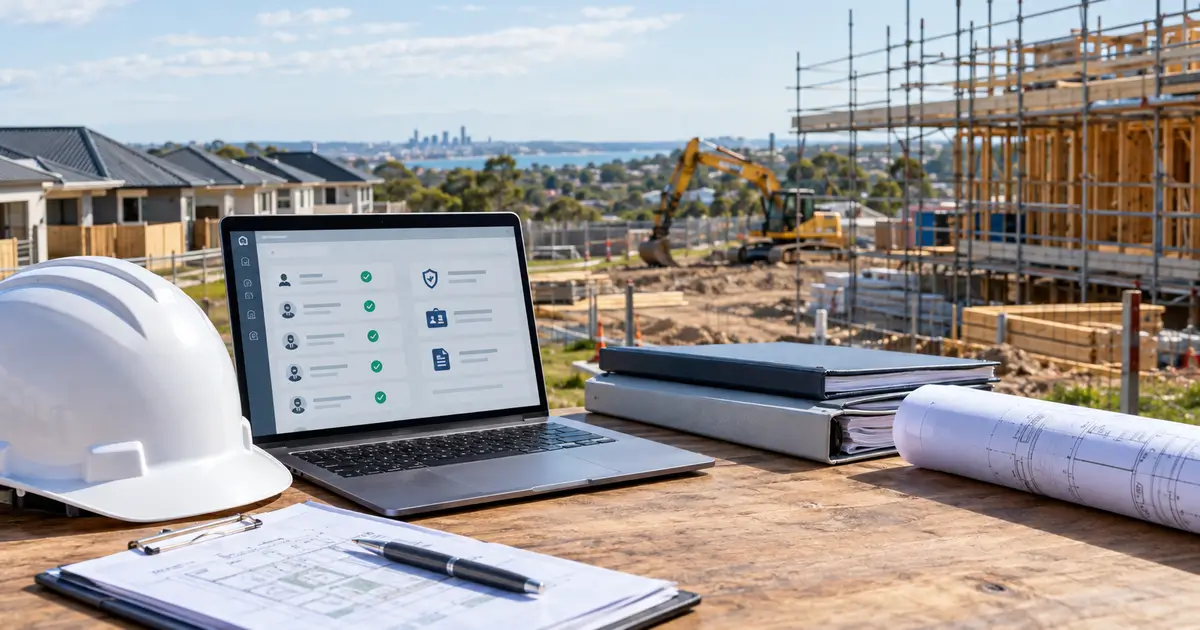
Search contractor management software in Australia and almost every result is built for the same buyer: the organisation that engages contractors. Head contractors, principals, asset owners, facilities managers, mine operators, councils. These platforms onboard a contracting company, verify its insurance and licences, induct its workers before they reach the gate, permit the high-risk work, and keep the record current while the work runs.
That is not software for contractors to run their business in. A subcontractor who lands on one of these pages is the user of somebody else's portal, not the customer.
Key Takeaways
- Australian contractor management software is principal-side: it prequalifies the company you engage, verifies each worker it sends, inducts before site access, permits high-risk work and records sign-in.
- The legal spine is the WHS laws. A construction project worth $250,000 or more must have a principal contractor with a written WHS management plan, and the principal must obtain safe work method statements before high risk construction work starts.
- Trade licensing is a separate, state-based obligation checked against a government register. Software records that you checked, and when.
- The burden is two-sided. Contractors re-answer the same safety questions for every client, which is why portability of the contractor record is the most consequential thing to ask a vendor.
- Most platforms publish no pricing. The models split three ways: per worker, per contractor company tiered on risk, and quoted on construction volume.
What Contractor Management Software Is, and Who Buys It
Contractor management software is the system of record for the companies and people you engage, and whether they are cleared to be on your site today. The buyer is always the party carrying the duty.
Two neighbours get confused with this category. Safety software owns the site's WHS system — SWMS templates, risk registers, incidents — while contractor management owns the identity and currency of the entities and individuals you engage. Job management software owns the contract — stages, variations, progress claims, retention. Beware a third, unrelated product: Deel and Remote sell "contractor management" that means paying freelancers globally.
The Australian Compliance Spine
A construction project is a project involving construction work costing $250,000 or more, and each such project must have a principal contractor — only one at a time (Safe Work Australia, model Code of Practice: Construction Work, November 2024). That is the threshold that turns a compliance problem into a documented obligation.
The principal must prepare and review a written WHS management plan before work commences, make each person carrying out the work aware of it before they start, and keep a copy until the project completes — or two years after a notifiable incident. It must also obtain each safe work method statement before high risk construction work starts.
High risk construction work is defined by regulation 291 of the model WHS Regulations: fall risk above two metres, asbestos disturbance, confined spaces, trenches deeper than 1.5 metres, tilt-up or precast concrete, energised electrical installations (reg 291 as in force). Those are what a permit-to-work gate gates. And the reason it lands on you: under WHS laws contractors and subcontractors are workers, so the ones you engage sit inside your duty of care (ComplyFlow, retrieved 14 October 2026).
Licensing is a state matter, and separate from WHS
A WHS management plan does not tell you whether a trade is legally allowed to do the work. In NSW, a contractor licence is required for residential building work, wiring, plumbing, draining, gasfitting, air conditioning or refrigeration work, checked on the public register (Service NSW, last published 15 August 2025). In South Australia, individuals and businesses must be licensed as building contractors, including subcontractors if they carry out or organise building work (SA.GOV.AU), searched on the CBS register (Consumer and Business Services).
Verification is a lookup plus a record of when you did it. For how that works on an Adelaide project — which insurance is statutory and which is only a head contract term — see our guide to verifying a trade's licence and insurance before engagement.
The Contractor Lifecycle, Stage by Stage
What separates platforms is whether each stage writes to the same record and stays current after onboarding.
Prequalification. The company is assessed before engagement: ABN, safety management system, the licences attaching to the scope of work, insurance certificates of currency. Cm3 runs this as a managed service, with in-house assessors reviewing a Business Risk Profile against hazard-specific risk reviews (Cm3). ComplyFlow runs it against your own form, routing each section to the reviewer who should judge it (ComplyFlow).
Expiry tracking. Most of the value sits here, because the common failure is a document valid at onboarding that lapsed six months later. On the day an insurance lapses, ComplyFlow changes the company's status and flags the worker at the next sign-in scan (ComplyFlow pricing, retrieved 14 October 2026). LinkSafe describes the loop as prequalification, monitoring, reminders, re-upload, non-compliant flag, re-approval (LinkSafe, retrieved 14 October 2026).
Site induction and permit-to-work. General construction induction training is the baseline under Part 6.5 of the model WHS Regulations; the site induction is a separate, per-site step. The better platforms gate progress on its completion rather than filing it as a document (Unifii, Altora). Unifii connects approval to the permit so higher-risk work proceeds only when inductions and competencies are current. MRI Evolution Contractor runs permits digitally and records "proof of attendance", which matters because the same sign-in data supports payment accuracy (MRI Software AU, dated 12 May 2026).
The company record and the worker record are not the same thing
An approved company does not mean the person it sends is cleared for this work, on this site, today. The company record holds the legal entity, the ABN, the insurance certificates and the safety management system. The worker record holds the White Card, the high risk work licence, the tickets and the site induction. A platform holding only the company record cannot answer the question a site gate needs answered.
The Other Side of the Portal
A subcontractor working for several head contractors can face a separate prequalification for each, re-entering the same evidence in a different format. OnePack calls it "days of duplicate paperwork"; CMiC, from the principal's side, notes a subcontractor maintaining logins across a dozen or more contractor portals, with that drag priced into every bid (OnePack, CMiC, both retrieved 14 October 2026, vendor claims). You pay for it either way.
Portability is the fix. Cm3's contractor FAQ is unambiguous: "No, Cm3 is one fee, for one year, for unlimited clients!" (Cm3, retrieved 14 October 2026). ComplyFlow's worker licence follows the person across clients; Quartex, by a competitor's account, charges per connection.
A head contractor cannot contract out of its WHS duties in substance, so it has to verify. The question is whether the way you verify externalises cost and delay onto your trade base.
Australian Options and How They Charge
| Platform | Principal-side role | Pricing basis | Published price |
|---|---|---|---|
| ComplyFlow | Prequal to permit and sign-in on one record | Per worker; per company prequal; free client starter | Worker AU$35/yr; prequal AU$100/yr; Starter free to 5 users and 5 sites. Ex GST. Checked Oct 2026 |
| Cm3 | Managed prequal with in-house assessors; OnSite, Induct, permits | Annual fee tiered on the contractor's Business Risk Profile | Quote only. One fee covers unlimited clients |
| Unifii | Onboarding, licences, inductions, permit-to-work, site access and monitoring in one workflow | Quote based, configured per organisation | Quote only |
| Pinnacle | Vendor records, compliance tracking, inductions and work orders; CMMS-led | Quote based | Quote only |
| INTELICS CMP | Vendor screening, document verification, permits, task competency; state-specific | Quote based | Quote only |
| Accessly | Facilities-management platform: contractor prequalification, key and access control, visitors | Quote based | Quote only |
| Rapid Global | Prequal, inductions, access control, permits, incidents, audits | Quote based, Rapid One suite | Quote only |
| HammerTech | Construction safety plus subcontractor management, permits, access | Quoted on construction volume, sites, complexity; no per-seat | Quote only |
| LinkSafe (Civica) | Prequal, inductions, credentials, permits, visitor management | Not stated on the pages read | Quote only |
| Ideagen Workforce Safety (formerly Damstra) | Credential verification, permits, induction, site access | Quote based | Quote only |
| MRI Evolution Contractor | Prequal, right-to-work, digital permits, proof of attendance | Quote based | Quote only |
| Mitti (by SafetyCulture) | Contractor product inside a broad inspection platform | Per seat, or fixed price per location for multi-site | Premium $24 per seat/mo annual, $29 monthly, excl. taxes. Billing is AUD or USD depending on contract; confirm which applies. Checked Oct 2026 |
| MyPass Global | Worker-held portable verification passport | Per active worker; flat rate above 49 | Published in AUD, excludes GST |
| SiteConnect | Contractor safety management, inductions, sign-in | Per "Managed Worker"; unlimited sites and subcontractors | Priced in GBP on the page fetched. Confirm the AUD rate |
Three shapes sit behind that table. Per worker (ComplyFlow, MyPass) scales with headcount and is usually portable. Per contractor company, tiered on risk (Cm3) scales with the contractor rather than with you, which is why the contractor often pays it. Quoted on construction volume (HammerTech, Rapid Global and most others) has no comparable list price, so any Australian comparison printing a single number for these vendors is estimating.
Wesfarmers announced on 24 July 2026 it had agreed to sell Cm3, part of its Blackwoods Group, to Achilles, subject to FIRB approval (Wesfarmers).
Where This Sits in a Builder's Software Stack
Contractor management is one layer, with clean handoffs. The site's own WHS system is construction safety software. The contract side is job management software. The hours a worker puts against a job are construction time keeping software. The wider picture is in our construction management software guide. The failure mode across all four is drift: the same worker's ticket stored in three systems, current in one and lapsed in two.
This bites us at procurement, so that is where we put the control. Our Adelaide trade-quote desk verifies that a trade is licensed and insured before that trade is engaged, and sorts every requirement into one of three buckets — statute, licence condition, or head contract term. Cyberidge runs a gated six-stage process from site assessment to handover, and a gate is only a control if the record of what passed through it lives somewhere. You can see that on the Cyberidge delivery record, start with a trade quote through DDDI, or read how we approach builder enablement.
Frequently Asked Questions
What is contractor management software?
Principal-side software that prequalifies a contracting company, verifies each worker's licences, insurances and competencies, inducts workers before site access, permits high-risk work, records sign-in and keeps the record current. The buyer carries the WHS duty; the contractor is a user of the portal, not the customer.
What is the difference between contractor management software and safety software?
Safety software runs the site's own WHS system: SWMS, risk registers, inspections, incident reporting. Contractor management runs the identity and currency of the companies and workers you engage. They connect at the SWMS, but they are different records.
Does Australian law require me to use contractor management software?
No. The law requires that a project worth $250,000 or more has a principal contractor, a written WHS management plan prepared before work commences, and safe work method statements obtained before high risk construction work starts (Safe Work Australia, November 2024).
How much does contractor management software cost in Australia?
Three shapes: per worker, per contractor company tiered on risk, or quoted on construction volume. Most vendors publish nothing. ComplyFlow is the exception at AU$35 per worker per year plus AU$100 for a company prequalification, excluding GST (checked October 2026).
Do subcontractors have to pay?
Often yes. Cm3 charges the contractor an annual fee tiered on their Business Risk Profile, covering unlimited clients. ComplyFlow registration is free for a contractor, but the AU$35-a-year worker licence applies once a client requires one (it is portable across clients), and its AI-reviewed company prequalification is AU$100 a year where a client asks for it (ComplyFlow, checked October 2026). Before you mandate a platform, ask whether the contractor record is portable, because the trades feel both the cost and the delay.