
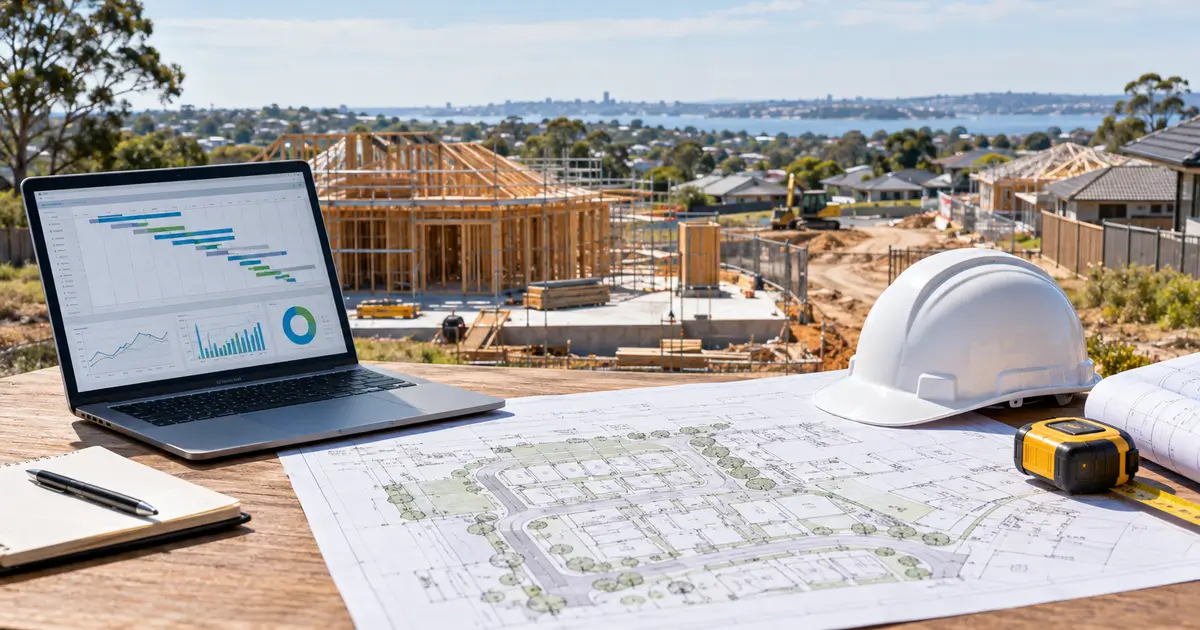
Project controls is the function on a building project that measures what has happened, forecasts where the job will finish, and reports the gap to the people who decide what to do. It does not make the decisions. That last sentence is the whole discipline, and the professional bodies say it more precisely than any software vendor does.
Almost every authority writes for capital projects: refineries, rail, defence. If you run a residential or mid-tier building business doing five to thirty homes a year, those definitions are correct and unusable. This page gives you the definitions from the bodies that wrote them, then translates them to your scale.
Key Takeaways
- Project controls is the measuring, forecasting and reporting function. Management is the deciding and correcting function, and the professional bodies draw that line explicitly.
- The discipline contains planning and scheduling, estimating and cost engineering, cost control, progressing and earned value, forecasting, risk, change, reporting and information control.
- Cost control is not cost accounting. The Construction Industry Institute states it plainly: the cost breakdown structure and the chart of accounts answer different questions.
- CPI and SPI are ratios against a baseline. Neither tells you anything until you have a baseline you are disciplined about not moving.
- A builder doing five to thirty homes a year needs a baseline programme, stage-based claims against percentage complete, a cost-to-complete per job, variation control and a monthly margin review.
What Project Controls Actually Is
The Association for Project Management defines project controls as "the practice of assessing if the proposed work is worth doing, of preparing for work before it is done, of thinking about what might go wrong before it is done, and of doing something about it if it does" (APM, checked October 2026). Once work has started, APM says, controls measure what has been done objectively, forecast what might happen, and suggest action. It calls the practice "the analytical element of project management."
Mosaic Project Services, whose white paper is the definition most practitioners cite, defines project controls as "the data gathering, management and analytical processes used to predict, understand and constructively influence the time and cost outcomes of a project or program through the communication of information in formats that assist effective governance and management decision making" (Mosaic, WP1093).
The Construction Industry Institute calls the function "really the eyes and ears of management" (CII, Project Control for Construction, CII Cost/Schedule Controls Task Force, September 1987). That describes an information service, not an authority.
The Disciplines Inside the Function
Project controls is a collective term, and the bodies slice the disciplines differently, which matters when you evaluate software marketed against one vendor's version of the list. The CII covers planning, change management, estimating, scheduling, cost control, progressing and forecasting (CII, Global Project Control and Management Systems, RS244-1, publication dated February 2009). The ECITB narrows the technical core to estimating, planning, scheduling and cost control (ECITB, qualification document dated February 2024), and AACE International groups the cost-side disciplines under cost engineering (AACE International, checked October 2026).
| Discipline | What it produces |
|---|---|
| Planning and scheduling | The time-phased plan: what, when, by whom, with what resources |
| Estimating and cost engineering | The predicted cost of delivering a defined scope |
| Cost control | Budgeted versus actual cost by cost element, with trends |
| Progressing and earned value | The objective status of completion |
| Forecasting | The updated prediction of final cost and time |
| Risk management | Threats and opportunities, and their cost and time consequences |
| Change management | Controlled movement of scope, and its effect on the baseline |
| Reporting and performance management | Management information that supports decisions |
| Information and document control | The single version of the project record |
The one most often missing in smaller Australian building businesses is the last. Information and document control is unglamorous, and it is why two people on the same job can quote different numbers for the same variation.
Baselines, Control Accounts and Contingency
Two breakdown structures do two jobs. The Work Breakdown Structure organises work by deliverable. The Cost Breakdown Structure organises all cost elements, direct and indirect. The CII described the relationship precisely: the WBS "is a part of the CBS, but includes only those CBS elements against which progress is tracked" (CII, Project Control for Construction, Publication 6-5, CII Cost/Schedule Controls Task Force, September 1987). Control accounts sit at one level of the CBS: the accounts against which actual costs are collected and compared to what was budgeted.
Cost control is not cost accounting. The CII states it directly: cost control is "the process to catalog and analyze budgeted and actual expenditures of activities for purposes of timely identification of cost trends, problems, and opportunities during the course of the project. Cost control is not cost accounting" (CII). Your accountant's chart of accounts is built for statutory completeness and tax treatment. Your cost breakdown is built to expose where money on this job is going wrong while you can still act. Forcing one structure to answer both is why job costing in a general ledger often tells a builder very little. Our guide to construction cost management software covers the committed-versus-actual mechanics.
A baseline is the frozen reference you measure against. Without one, a variance is just a number, and an argument about a delay becomes a memory test. The CII distinguishes the control schedule from the working one: schedule control "requires a Control Schedule at the outset of construction", and if that schedule is too detailed it loses its usefulness (CII, Publication 6-5, September 1987). The working schedule is the current plan the supervisor runs the site by. Keeping both means a variation moves the baseline and records the movement, while a weekly re-plan does not. Contingency belongs to the baseline, not to the variations: you are controlling it only if you can say how much remains unspent and what it was intended to cover.
CPI and SPI: What They Measure
Both are ratios against a baseline, and both come out of earned value management. CPI compares the value of work completed against what it actually cost. SPI compares the value of work completed against the value you planned to complete by now.
Three inputs do the work: planned value, the budgeted cost of the work scheduled to date; earned value, the budgeted value of work actually performed; and actual cost, what you have spent performing it (PMI, checked October 2026). Then CPI = EV / AC and SPI = EV / PV. Above 1.0 on either is ahead; below 1.0 is behind on schedule or over on cost.
The figures below are illustrative. They are round numbers chosen so the arithmetic is visible, they are not a benchmark, and no index derived from fictional numbers is a performance target.
| Item | Value | What it is |
|---|---|---|
| Planned value (PV) | $80,000 | Budgeted cost of the work scheduled by this point |
| Earned value (EV) | $72,000 | Budgeted value of the work actually completed |
| Actual cost (AC) | $79,000 | What that completed work actually cost |
| CPI = EV / AC | 0.91 | 91 cents of budgeted value per dollar spent |
| SPI = EV / PV | 0.90 | 90% of the scheduled value delivered |
This job is behind and over budget, and the two indices agree. That is the easy case. The dangerous case is when they disagree. Take CPI at 1.05 and SPI at 0.85: work is being done for less than budgeted, but the job is well behind. On a residential build that usually means work is being completed cheaply but in the wrong sequence, often because an early stage was claimed as substantially complete before it really was, so later trades pay for the shortcut.
Earned value has a real limit. It depends on a percentage complete, frequently assessed by the same people whose performance it measures. When the completion rule is vague, CPI and SPI report a confidence the data does not support, and practitioners describe the result as an illusion of control. The fix is to agree the completion rule for each work package before work starts.
Project Controls Observes. Management Decides.
This is the sharpest idea in the discipline and the professional bodies make it explicitly.
APM: "Project controls teams are the people who collect project data and convert it into information and insight. This insight is then a catalyst for action" (APM, Senior Managers' Guide to Project Controls, first edition 2023). Mosaic is blunter: "the 'controls' role is information generation; management's role is making effective use of the information" (Mosaic). Mosaic calls performance measuring a controls function and performance correcting a management function. APM's earlier Introduction to Project Control added the consequence: without effective responses to actual and potential problems, "the project is merely monitored" rather than controlled (APM, Introduction to Project Control).
A system that tells you a house will finish four points below its budgeted margin has produced a report. Control begins when somebody named decides what happens next, and by when.
Project Controls for a Residential or Mid-Tier Australian Builder
At five to thirty homes a year you do not need a controls department, an earned value system or a risk register with modelled probabilities. You need five habits.
| The habit | Scales down from |
|---|---|
| A baseline programme per job | Control schedule and baseline management |
| Stage-based claims against percentage complete | Progressing and earned value |
| Cost to complete per job, kept current | Forecasting and forecast-to-complete |
| Variation control in writing before work proceeds | Change management |
| A monthly margin review on every active job | Reporting and performance management |
A baseline programme. One programme per job, dates fixed and issued before site start, that you date variations against. The working programme updates weekly; the baseline moves only through an approved variation.
Stage-based claims against percentage complete. The claim follows the stage schedule and the percentage actually achieved, not the calendar. A stage claimed at 40 per cent because the month ended is a claim that must be reconciled later. The anatomy of a claim under security of payment is covered in construction invoicing software.
Cost to complete per job, kept current. Committed cost, plus actual cost, plus what is left to spend, per cost code, updated monthly. A job that has spent half its budget and done a third of the work has a problem no cash report will show you.
Variation control. Every change costed and approved in writing before the work proceeds, which stops unauthorised scope quietly consuming the margin. Cyberidge runs this inside a gated six-stage process where each stage has a defined output and a sign-off condition before the next begins, with independent inspections at each milestone (Cyberidge delivery).
A monthly margin review. Every active job's forecast margin read against the margin it was won on, with any downward movement asked about while the job is still open. Margin rarely disappears in one event; it fades in small movements that each looked reasonable at the time.
DDDI runs the systems side of this for builders: scheduling that sequences trades, weather buffers and inspection windows up front, and cost control holding budget, committed and actual against a forecast to complete on every job (DDDI platform engines). That is our own operational practice, not a benchmark drawn from other builders. What you are deliberately not doing at this scale is calculating CPI and SPI per house or modelling risk in probability distributions. Those techniques earn their overhead on jobs with hundreds of activities and a buried critical path.
Frequently Asked Questions
What is project controls in construction?
The function that measures what has happened on a project, forecasts where cost and schedule will finish, and reports the difference to the people who make decisions. It covers planning and scheduling, estimating, cost control, progress measurement, forecasting, risk, change and information control.
What is the difference between project controls and project management?
Project controls observes and reports; project management decides and corrects. APM describes project controls as the data, analytical, reporting and forecasting part of project management, and Mosaic draws the line at information generation versus making effective use of the information.
What is the difference between cost control and cost accounting?
Cost accounting tracks receipts and expenditures to satisfy bookkeeping, tax and statutory requirements. Cost control catalogs budgeted and actual expenditure to identify cost trends and problems early. The CII notes the cost breakdown structure used for control seldom matches the chart of accounts.
What are CPI and SPI?
CPI is earned value divided by actual cost: below 1.0 means each dollar buys less than planned. SPI is earned value divided by planned value: below 1.0 means you have delivered less than planned by now. Both are measured against a baseline.
Does a small builder need project controls?
Not a controls department. A builder doing five to thirty homes a year needs a baseline programme per job, stage-based claims against actual percentage complete, a current cost to complete on every job, written variation control, and a monthly review of each active job's forecast margin.
What is a control account?
A level within the cost breakdown structure where actual costs are collected and compared against the budget for that element. It is where cost control happens, usually at a more summary level than the detail used for reporting work in the field.
What is the difference between a control schedule and a working schedule?
The control schedule is the baseline, set before construction starts and used for measuring progress and validating variations. The working schedule is the current plan the site runs to. Keeping both means delays are measured against a fixed reference rather than reconstructed from memory.
What to Do With This
Project controls is measurement, forecasting and reporting so that somebody with authority can decide. Strip away the capital-projects apparatus and that definition holds at any size of building business; only the machinery changes.
If you are choosing the systems that carry this function, start with the category rather than the vendors. Our guide to construction management software maps how estimating, cost, scheduling and reporting modules fit together, and the best construction management software in Australia comparison covers what each option does at each business size. Where you need tooling built for the controls layer, construction project controls software covers that market and where a mid-tier builder fits in it.
If what you want is the operating system rather than the software decision, our builder-enablement solutions are where DDDI does this work: scheduling, cost control and quoting systems built onto a real building business rather than a demo environment.