
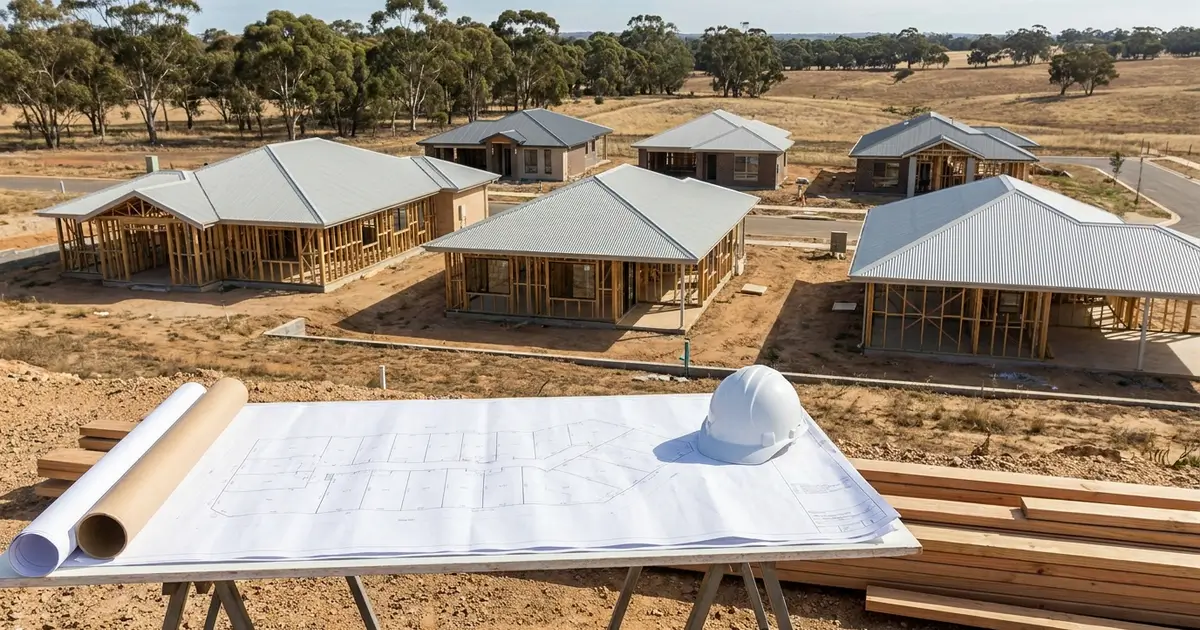
Short answer: South Australia issues no document called a building permit. Building work requires building consent, one of the consents in a development approval under the Planning, Development and Infrastructure Act 2016 (SA). Planning consent is assessed against the Planning and Design Code; building consent against the building rules — the Building Code as adopted and varied in SA, plus Ministerial building standards. Everything lodges through PlanSA, and you elect whether a private certifier or your council's building team assesses the building rules.
Key Takeaways
- The statutory term is building consent. "Building permit" is a national search habit, not a South Australian instrument.
- It is one consent among up to three. Planning, building and land division consent can sit in a single approval, in any order.
- No building work does not mean no consent. A change in land use can require building consent because fire safety requirements change.
- You choose the assessor. At lodgement you elect a private building certifier or the council building team.
- Occupancy is a separate, later certificate. A Certificate of Occupancy is issued after construction and gates occupation.
- One rulebook, many decision-makers. The Planning and Design Code is statewide; the relevant authority and referrals are site-specific.
Building permit South Australia: translating the national question
Anyone searching building permit South Australia wants building consent within a development approval.
| National guides say | South Australia has | Decided by |
|---|---|---|
| Building permit | Building consent | Council building officer, or independent accredited professional |
| Planning permit | Planning consent | Assessment Manager, Assessment Panel, or accredited planning professional |
| Two separate approvals | One development approval containing one or more consents | The relevant authority for each consent |
Where the rules live
PlanSA states the rule plainly: "Development that involves building work requires building consent as part of its approval. For building consent to be granted, the building work must comply with the building rules" (PlanSA — Building, retrieved 23 October 2026). Three instruments matter:
- The PDI Act 2016 creates the consents. Section 102(1) has the authority assess planning consent against the Planning Rules and building consent against the Building Rules; section 102(8) makes a development approved only when all relevant consents are granted.
- The building rules are the Building Code — PlanSA describes it as "building rules for building work across Australia" including state-level variations — plus Ministerial building standards, which "are used to assess a building consent and are part of the building rules under the PDI Act".
- The Planning and Design Code governs planning, statewide: the same instrument applies in the Adelaide CBD and in a regional council area.
PlanSA is the system, not the rulebook. The Local Government Association of South Australia says "all planning and building development applications are lodged and assessed through PlanSA" (LGA SA, retrieved 23 October 2026). The national building permit guide carries this framework state by state.
One development approval, several consents
PlanSA lists three consent types — planning, building and land division — noting "one or more of the following types of consents may be required" (PlanSA — Types of consent, retrieved 23 October 2026).
The order is yours. Section 102(6)(a) provides that where a development needs several consents, "the consents need not be granted in any particular order" — building consent can precede planning consent. What cannot happen is skipping one; see planning approval versus building permit.
Land division pulls planning consent in. Where required, the approval must include one.
Accepted development skips planning consent. A carport or shop fit-out "only requires building consent as part of its approval. No planning consent is required" (PlanSA — Assessment pathways, retrieved 23 October 2026).
Consents can run in parallel, so the question is which sits on the critical path. Lodging both at once removes a serial wait but raises the completeness bar.
Who assesses building consent: private certifier or council
Adelaide Hills Council states that when lodging a development application "you can elect to have your building rules assessment undertaken and approved by either a private building certifier or through Council's building team".
PlanSA frames it through accreditation: an accredited building professional at Building Level 1, 2, 3 or 4 "make[s] decisions on building consent as per their accreditation level", and council building officers can assess building consent "if they are accredited" (PlanSA — Relevant authorities, retrieved 23 October 2026). Assessment Manager and Panel roles dominate planning but do not map onto the building side, so one approval can have two decision-makers.
What it covers is a technical review, not a merit review: structural adequacy, fire safety, health and amenity, energy efficiency, and disability access. The certifier or council officer does not design the building or grant planning consent — that boundary is covered in building certifier versus building surveyor.
Cyberate Project Management (CPM) is part of DDDI Group, which publishes this article. Links to CPM are related-party referrals, not independent recommendations. CPM provides development approval and subdivision management in South Australia only; approval rules, fees and services differ in other states. CPM is not a certifier, building surveyor, consent authority or permit issuer. What it manages is the pathway around that decision. If the pathway is the bottleneck, book a free consultation on a South Australian development approval.
For the Victorian equivalent — different instrument, regulator and appointment model — see how the Victorian building permit system works.
What you lodge, and how lodgement works
A building permit application in South Australia lodges online under the PDI Act through PlanSA, not with a council that then assesses it. One exception matters: "if your application is for an outline consent, you are unable to submit online" (PlanSA — Lodge online, retrieved 23 October 2026).
The document set is prescribed. PlanSA's checklist says documentation "is set out by Schedule 8 of the Planning, Development and Infrastructure (General) Regulations 2017", at a level that "depends on what you are proposing". Every application carries a signed form recording the site address, applicant, landowner and builder details, land use including development cost, and the chosen assessors. Most also require an Electricity Declaration and a Native Vegetation Declaration. The pack is detailed in what a building permit application contains.
Fees precede assessment. PlanSA confirms "all development applications incur fees in order for the assessment process to be undertaken by a planning professional", set by Ministerial fee notice in the Government Gazette. Building assessment for Class 1 work is $538 or 0.25 per cent of total development cost, whichever is greater; that fee is taxable while lodgement fees are exempt, a GST distinction to carry into the cost plan. The arithmetic is in what a building permit costs.
Outline consent is a different instrument. Section 120 of the PDI Act lets a relevant authority grant one, and Practice Direction 18 makes the State Planning Commission that authority. Where one is granted and a later planning consent application follows, the authority "will only assess those aspects of the application that were not granted through the outline consent" (PlanSA — Outline consent, retrieved 23 October 2026).
Assessment, conditions and occupancy
Verification comes first. Before formal lodgement the portal checks which consents are required, the relevant authority, and whether documents are attached, then requests payment; assessment starts once paid.
Assessment produces a decision notification form. The DNF sets out the conditions, where the consents interact: a building condition cannot cure a planning condition, and a planning condition that changes the built form can invalidate drawings the building assessor approved. Mandatory notifications run during construction; missing one can attract an expiation and affect the occupation application.
Occupancy is separate, and it is a hard stop. PlanSA states a Certificate of Occupancy is needed for all new buildings and applicable work under the PDI Act, excluding garages, carports and verandahs, and "a building approved under the PDI Act cannot be occupied until the Certificate of Occupancy has been issued", with penalties up to $10,000 (PlanSA — Certificate of Occupancy, retrieved 23 October 2026). The requirement extended to Class 1a houses from 1 October 2024. Council-issued certificates are priced under the PDI (Fees) Notice; certifier-issued ones commercially.
Approvals lapse on their own clock. Regulation 67 of the PDI (General) Regulations 2017 provides that a consent or approval lapses two years after the operative date of the development approval, or three years where the development has been lawfully commenced by substantial work on site within those two years, with extensions under section 126(3). That is separate from the assessment clock, covered in SA development approval timeframes and compared across states in how long a building permit takes.
How South Australia differs from the other states
| State | The approval | Instrument |
|---|---|---|
| South Australia | Building consent, inside a development approval | PDI Act 2016 (SA); Building Rules |
| New South Wales | Construction certificate, or complying development certificate | Environmental Planning and Assessment Act 1979 (NSW) |
| Victoria | Building permit | Building Act 1993 (Vic); Building Regulations 2018 (Vic) |
| Queensland | Building development approval | Building Act 1975 (Qld) |
| Western Australia | Building permit, certified or uncertified | Building Act 2011 (WA) |
| ACT / NT | Building approval / building permit | Building Act 2004 (ACT); Building Act 1993 (NT) |
Two rows break the pattern. NSW has no building permit — a construction certificate or a single complying development certificate does the work — and Queensland calls it a building development approval. Tasmania runs a three-tier risk model under the Building Act 2016 (Tas) — low risk, notifiable work on a Certificate of Likely Compliance, and permit work issued by council — which does not collapse into one row here, so it is covered in the national guide.
The names matter less than the structure. Other states treat building approval as a free-standing instrument obtained after or alongside a planning decision; South Australia folds it into the development approval, so one DNF can carry conditions from two rulebooks.
What this means for an Adelaide project
A building permit Adelaide search resolves the same way, but metropolitan sites add referral triggers. Four decisions carry most of the risk:
- Name the consent. "Building permit" gets routed to a planning question. "Building consent under the PDI Act" gets an assessor.
- Choose the assessor deliberately. Council or private certifier changes fees, the queue and the dispute route.
- Test whether a change of use triggers building consent alone. A fit-out with no new structure still needs it if the classification moves.
- Programme occupancy separately. The Certificate of Occupancy has its own application, fee and timing, and gates occupation.
Confirm zone and overlays with SAPPA first: overlays determine which referrals the application attracts, and referrals drive much of the elapsed time.
For a second read, read Cyberate PM's SA development approval process explainer, or book a free consultation on a South Australian development approval. Cyberate Project Management (CPM) is part of DDDI Group, which publishes this article. Links to CPM are related-party referrals, not independent recommendations. CPM provides development approval and subdivision management in South Australia only; approval rules, fees and services differ in other states. CPM is not a certifier, building surveyor, consent authority or permit issuer, and nothing here guarantees approval or a timeline.
Frequently Asked Questions
What is a building permit called in South Australia?
Building consent. The PDI Act 2016 creates three consents — planning, building and land division — and building consent covers building work. No South Australian agency issues a document titled "building permit".
Is building consent the same as a development approval?
No. It is one component, alongside planning consent and, where land is divided, land division consent. Section 102(8) of the PDI Act provides that a development is approved only when all relevant consents have been granted.
Who issues building consent in SA: council or a private certifier?
Either, and you choose at lodgement. Adelaide Hills Council states you can elect a private building certifier or the council's building team; PlanSA describes the private side as accredited building professionals at Building Levels 1 to 4.
Can I need building consent without doing any building work?
Yes. PlanSA states building consent may be required even where no building works are proposed, because a change in land use may require different building fire safety requirements.
When do I need a Certificate of Occupancy?
After construction, before occupation. A building approved under the PDI Act cannot be occupied until the certificate issues, penalties of up to $10,000 may apply, and it has covered Class 1a houses since 1 October 2024, excluding garages, carports and verandahs.
Does the Building Code of Australia apply in South Australia?
Yes, with state variation. PlanSA describes the Building Code as setting out building rules for building work across Australia with state-level variations; Ministerial building standards form part of the building rules used to assess a building consent.