
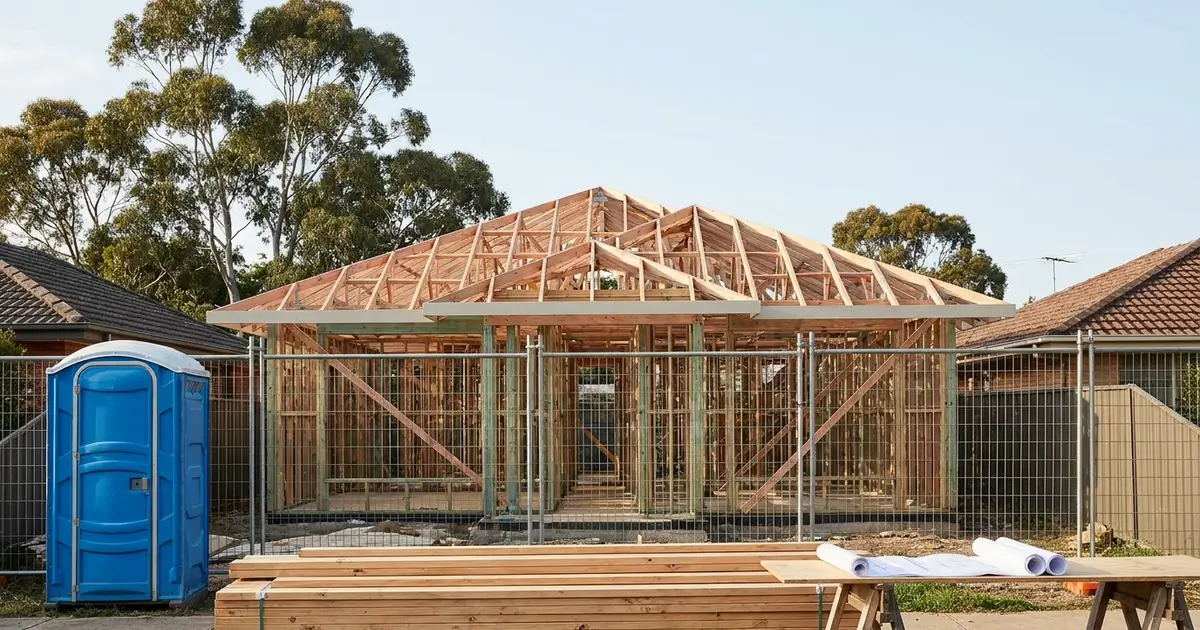
Short answer: a building permit application is the construction-stage approval for the work shown on your drawings, assessed against the building rules — the National Construction Code as each state adopts and varies it — not against planning rules. It authorises that specific work, on those specific plans, subject to conditions and mandatory inspections. It does not grant planning consent, authorise a land division, or entitle anyone to occupy the building. It goes to a building surveyor, certifier or council depending on the site, and it is a different document with a different decision-maker from the planning approval that usually has to exist first.
Key Takeaways
- Two decisions, not one. Planning approval tests whether the development should happen; the building permit application tests whether the construction complies. Every jurisdiction reviewed here treats them as separate instruments with separate decision-makers.
- The statutory term changes at the border. "Building permit application" is the Victorian and Western Australian name. South Australia grants building consent inside a development approval; NSW issues a construction certificate or complying development certificate; Queensland issues a building development approval.
- Who assesses is a state policy choice. Victoria, NSW, Queensland and the NT let you appoint a private practitioner. Western Australia, South Australia, Tasmania and the ACT route the permit through local government.
- Fees are never national. Statutory fees are set by regulation, fee notice or council, and assessors add their own. A single "average permit cost" is a marketing figure.
- No national decision deadline exists. Western Australia's permit authority has 10 business days on a certified application and 25 uncertified. No period measures elapsed project time.
- Incomplete lodgement is the controllable failure. A missing certificate, an understated cost of works or an unresolved referral stops the clock while holding costs keep accruing.
What a building permit application authorises — and what it does not
A building permit is a written approval from a building surveyor or certifier that the proposed work complies with the relevant building regulations. Victoria's Building and Plumbing Commission (retrieved 23 October 2026) calls it an approval that "allows the building work to be undertaken according to the approved plans, specifications and other relevant documentation." Under the Building Act 1993 (Vic) and the Building Regulations 2018 (Vic), all building work requires a permit unless an exemption exists. Western Australia's Building Act 2011 states the same rule at section 9.
The permit is specific, not general. It attaches to a plan set, a specification and a site. Change the footing design, add a storey or move a boundary wall and the approval no longer describes what is built. It is a construction test, not a planning test: planning asks whether the development is acceptable in context (land use, siting, height, character, amenity, heritage, environmental risk), while the permit application asks whether the construction complies (structural adequacy, fire safety, health and amenity, energy efficiency, waterproofing, access).
| The permit application does not… | Because that decision belongs to… |
|---|---|
| Grant or vary planning consent | The planning authority, under the planning Act and scheme |
| Approve a land division or boundary realignment | The land division consent process (SA) or subdivision approval (other states) |
| Certify the building is safe to occupy | An occupancy permit, certificate of occupancy or occupation certificate issued at completion |
| Licence the trades doing the work | The separate trade licensing and registration regime |
| Approve work outside the approved plans | A variation, amendment or fresh permit |
| Compel a reporting authority to consent | The referral or concurrence process, which must resolve first |
That last row is where applications stall most often. Victoria's regulator states a surveyor cannot issue a building permit until any required reporting-authority consent has been received — for example from the council or water authority where you want to build over an easement. An application can be complete and still not issuable.
On sequencing, Victoria is explicit: where a planning permit is needed, "it must be issued from your local council before you can obtain a building permit." South Australia reaches the same result differently — because a development approval comprises one or more consents, planning and building consent can sit in a single application, which is why the statutory clocks for SA development approval run per consent. The two-layer distinction gets its own treatment in how planning approval and a building permit differ.
What "building permit" means in each state and territory
Most search results here are written for one jurisdiction. This table is not. Each row was verified against the regulator page cited, retrieved 23 October 2026.
| Jurisdiction | Statutory term | Who assesses and issues | Instrument |
|---|---|---|---|
| South Australia | Building consent, granted as part of a development approval | Council building officer, or independent accredited professional | Planning, Development and Infrastructure Act 2016 (SA); Building Rules |
| New South Wales | Development consent plus a construction certificate, or a complying development certificate (CDC) | Council or registered certifier | Environmental Planning and Assessment Act 1979 (NSW) |
| Victoria | Building permit | Relevant building surveyor, municipal or private | Building Act 1993 (Vic); Building Regulations 2018 (Vic) |
| Queensland | Building development approval (also called a building permit) | Local government or building certifier | Building Act 1975 (Qld); Building Regulation 2021 (Qld) |
| Western Australia | Building permit — certified (BA1) or uncertified (BA2) | Local government permit authority, on a certificate of design compliance | Building Act 2011 (WA); Building Regulations 2012 (WA) |
| Tasmania | Building Permit for permit work; Certificate of Likely Compliance for notifiable work | Council permit authority, or a building surveyor for notifiable work | Building Act 2016 (Tas) |
| Australian Capital Territory | Building approval (BA) | Licensed building surveyor as certifier | Building Act 2004 (ACT) |
| Northern Territory | Building permit, also called building approval | Registered building certifier | Building Act 1993 (NT) |
Four rows break the pattern people expect.
New South Wales has no document called a "building permit". Where development consent is required, work cannot start until a construction certificate has been issued and a principal certifier appointed. The NSW Government's approvals guidance adds a hard rule: a construction certificate issued after work starts is invalid, and an occupation certificate will not be issued. Complying development replaces both with a single CDC.
Western Australia splits the application by who certified the design. A certified application (form BA1) carries a certificate of design compliance from a registered building surveyor; an uncertified application (form BA2) does not and is assessed by the permit authority. The WA Building and Energy forms page lists both, plus the BA3 certificate itself.
Tasmania runs a three-tier risk model. Building Standards Tasmania sets it out: low-risk work such as fences, low decks, farm sheds and carports needs no building permit; medium-risk "notifiable work" — a detached house or unit including alterations — proceeds on a Notice of Work for a Certificate of Likely Compliance; high-risk "permit work" — commercial, industrial and public buildings, residential buildings needing a planning permit, owner-builder work and most work in hazardous areas — goes to council for a Building Permit.
Victoria has a dedicated treatment in how the BPC building permit system works, and South Australia's in the PlanSA building consent pathway. Before any of it, confirm zoning: the state-by-state planning map viewers are the fastest check, and overlays such as bushfire, flood, heritage or landslide convert a straightforward application into a referred one.
The application sequence, step by step
Confirm which approval you need. Start with the work, not the form. Some work is exempt; some needs a building permit only; some needs planning approval first; and a change of land use with no construction can still require building consent because fire safety requirements change with the classification. The exemption test is jurisdiction-specific and worth checking before you commission drawings — whether you need a building permit at all walks through the thresholds.
Appoint the assessor. In most states you cannot lodge without first appointing the person who will assess. In Victoria you appoint a registered building surveyor and apply through them; in the ACT you appoint a licensed building surveyor as certifier and lodge the appointment with Access Canberra; in Queensland the builder usually engages the certifier. The models are compared in building certifier versus building surveyor.
Assemble the pack. Architectural drawings, specifications, structural engineering, energy and water compliance, site and drainage plans, and state-specific certificates. The documents checklist by state itemises it.
Lodge and pay. Victoria asks for three copies of drawings, specifications and allotment plans with the completed form and prescribed information, plus the building permit levy. Most other jurisdictions lodge through a portal — PlanSA in South Australia, the NSW Planning Portal, council systems elsewhere.
Completeness check, referrals and information requests. Lodgement is the start of assessment, not the end of your work. An easement, a siting variation or a water authority requirement surfacing here can hold the whole permit. Western Australia's permit authority gives 21 days to supply requested information; Victoria's surveyor can refuse an application where declared cost information is materially incorrect.
The decision. Grant, grant with conditions, grant for a stage, or refusal. Victoria allows a permit for the whole or a stage of the work, and a refusal can be appealed to the Building Appeals Board. Work then has to commence and complete within prescribed periods or the permit lapses; inspections occur at nominated stages; and an occupancy certificate is required before occupation.
Who assesses your application
| Jurisdiction | Public assessor | Private assessor | Who the applicant deals with |
|---|---|---|---|
| Victoria | Municipal building surveyor | Private building surveyor | The surveyor you appoint |
| New South Wales | Council | Registered certifier | Your appointed certifier, who may differ from the principal certifier |
| Queensland | Local government | Building certifier | Usually the builder engages the certifier; you may appoint directly |
| Western Australia | Local government permit authority | Registered building surveyor certifies the design | Permit authority for the permit; your surveyor for the certificate |
| South Australia | Council building officer | Independent accredited professional | Whichever grants consent |
| Australian Capital Territory | — | Licensed building surveyor | Your appointed certifier, lodged with Access Canberra |
| Northern Territory | — | Registered building certifier | Your appointed certifier |
| Tasmania | Council permit authority | Building surveyor for notifiable work only | Council for permit work |
Two consequences follow. In New South Wales the certifier issuing the construction certificate and the principal certifier doing the inspections can be different people or the council — the NSW guidance makes the contract yours, not the builder's, and makes it illegal for a builder to influence your choice of certifier. In Western Australia the surveyor certifies the design and the local government assesses the application, so those are different people.
What you lodge with a building permit application
At overview level the pack falls into five groups: drawings (site plan, floor plans, elevations, sections, structural details); specifications; compliance certificates; site information (survey, levels, drainage, geotechnical); and the application form with fee and, where required, cost-of-works information.
Two state-specific requirements cause the most rejected lodgements. In Western Australia, a certified application must carry a certificate of design compliance (form BA3) from a registered building surveyor; without it you are lodging an uncertified application, at a higher fee and a longer decision period. In Victoria, the applicant declares the cost of building work on Form 1 and, since 26 November 2025, must provide component values that let the surveyor calculate rather than estimate the cost of work, all amounts including GST. A surveyor who reasonably believes information is materially incorrect can refuse.
That checklist covers the rest, including the owner-builder declaration where the owner is the applicant — a separate question covered in owner-builder permit requirements.
What a building permit application costs
There is no national building permit fee. Four components make up the total, set by different parties.
| Component | Set by | Example (source, retrieved 23 October 2026) |
|---|---|---|
| Lodgement or application fee | State regulation, fee notice or council | SA: $98.50 to $6,308 on total development cost, GST exempt |
| Assessment fee | State fee notice, council, or the assessor's own pricing | SA Class 1 building assessment: $538 or 0.25% of development cost, whichever is greater, GST taxable |
| Statutory levy | State legislation | WA Building Services Levy: 0.137% of value above $45,000, or $61.65 flat |
| Consultant and certification reports | The practitioner | Not statutory; scope-dependent |
The South Australian figures come from the PlanSA application fee schedule, unusually explicit about tax: lodgement fees marked exempt, building assessment fees marked taxable. A quoted permit fee mixing the two is not like-for-like. Western Australia publishes fee caps in the Building Act fee schedule: 0.19 per cent of estimated value for certified Class 1 or Class 10 work, 0.09 per cent for certified Class 2 to 9, 0.32 per cent uncertified, all with a $121.00 minimum.
Victoria's levy is calculated by the BPC from declared cost of work, at a general levy rate plus a domestic building dispute resolution levy, with the Building Reform Levy added for class 2 to 8 buildings in non-regional Melbourne where class 2–8 work reaches $1.5 million (it replaced the Cladding Rectification Levy on 1 July 2026). It is payable before a permit number is issued. The full landscape is in what a building permit actually costs; here the discipline is to note the financial year and GST treatment, and re-read the schedule at lodgement.
How long a building permit application takes
Separate two numbers that are routinely conflated — the statutory decision period the assessor must meet, and the elapsed project time from commissioning drawings to permit in hand. Only the first is regulated.
| Jurisdiction | Statutory decision period | Source (retrieved 23 October 2026) |
|---|---|---|
| Western Australia — certified | 10 business days | ABLIS WA service record, Building Act 2011 |
| Western Australia — uncertified | 25 business days | ABLIS WA service record, Building Act 2011 |
| Western Australia — applicant response to information request | 21 days | ABLIS WA service record |
| South Australia | Set by the PDI Act assessment pathway, per consent | PlanSA assessment stages |
| Other jurisdictions | Prescribed by state regulation; confirm with the assessor | — |
Those periods exclude everything before lodgement — documentation, engineering, planning approval — and any pause for information. Western Australia's 21-day response window is the clearest illustration: the clock that matters to your programme runs while the statutory clock does not. The same structure appears in the planning system, where most elapsed time sits for projects needing both approvals — South Australia's performance-assessed pathway can be suspended once for further information, excluded from the statutory clock but not from the holding period, and priced into a property development feasibility. A fuller comparison is in how long a building permit takes.
South Australia: building consent inside a development approval
South Australia does not issue a "building permit". Under the Planning, Development and Infrastructure Act 2016 (SA), development approval consists of one or more consents, and PlanSA's guidance on types of consent (retrieved 23 October 2026) sets out three: planning consent, building consent and land division consent.
Building consent is required for development involving building work — a carport, a garage, a swimming pool, demolition. It is granted by assessing the development against the building rules, which PlanSA describes as the Building Code together with state-level variations, and is usually granted by a council building officer or an independent accredited professional.
Two features are easy to miss. Building consent may be required even where no building work is proposed, because a change in land use can trigger different fire safety requirements. And if land division consent is required, the development approval must also include a planning consent — an infill subdivision is never a single-consent project.
A Certificate of Occupancy is required for all new buildings approved under the PDI Act, with garages, carports and verandahs excluded. PlanSA's guidance states a building cannot be occupied until the certificate is issued, that penalties of up to $10,000 may apply, and that the requirement extended to Class 1a (houses) from 1 October 2024. Application is made through the PlanSA portal, issued by the council or the certifier who assessed the building consent. The council fee is $59.50, marked taxable; a certifier-issued certificate is priced commercially.
Where CPM fits — and does not
Cyberate Project Management (CPM) is part of DDDI Group, which publishes this article. Links to CPM are related-party referrals, not independent recommendations. CPM provides development approval and subdivision management in South Australia only; approval rules, fees and services differ in other states. CPM is not a certifier, building surveyor, consent authority or permit issuer — building consent in South Australia is granted by a council building officer or an independent accredited professional.
What CPM does is manage the pathway around the consent: sequencing planning and building stages, assembling referral responses, and programming assessment so the building consent is not held up by a planning condition. If that is the bottleneck on a South Australian site, CPM's development approval service is the relevant one, and you can run a free site check first.
When an application stalls or a permit lapses
Cost-of-works information. In Victoria the surveyor's power to refuse where declared cost is materially incorrect is now explicit, and extends to owner-builder estimates substantially below normal cost.
A lapsed permit discovered late. Victoria prescribes commencement within 12 months and completion within 24 of issue for houses and outbuildings, and 12 and 36 months for most other building work. If a permit lapses and work continues, the BPC's lapsed permits guidance states the work becomes illegal, the surveyor may issue a building order to stop work, and where work is incomplete a new permit is required — through the same surveyor unless their appointment has been terminated. The Northern Territory sets two-year validity from issue.
No record of what was approved. Before buying a property with recent work, check existing approvals — council registers and portal lookups are the starting point. New South Wales also has an instrument for irregular work: a building information certificate, which Service NSW describes as ensuring the building will not be subject to regulatory action by the local council for seven years. That is a NSW certificate with a seven-year protective effect, not a national "7-year rule" making unapproved work lawful everywhere; no equivalent general principle exists in the other jurisdictions reviewed here.
Frequently Asked Questions
Who provides building approval in Australia?
It depends on the jurisdiction. Victoria: a municipal or private building surveyor. New South Wales: a council or registered certifier issues the construction certificate or CDC. Queensland: a local government or building certifier. Western Australia: the local government as permit authority, on a certificate of design compliance. South Australia: a council building officer or independent accredited professional. ACT: a licensed building surveyor. Northern Territory: a registered building certifier. Tasmania: council for permit work, or a building surveyor for notifiable work.
Do I need a building permit or a planning permit?
They answer different questions. A planning permit or consent decides whether the development may happen at all — land use, siting, height, amenity, heritage. A building permit application decides whether the construction complies with the building rules. Most projects needing both must obtain planning approval first.
What can I build without a building permit?
It varies by jurisdiction, and the exemptions sit in regulations rather than general guidance. Victoria lists possible exemptions including some minor alterations or demolitions, pergolas associated with houses, some garden sheds under 10 square metres and repair work for maintenance. Tasmania's low-risk category covers fences, low decks, farm sheds and carports. Do not infer an exemption from a size figure found online; check the regulation.
Is a construction certificate the same as a building permit?
Not in name, and the difference matters. A construction certificate confirms construction plans and specifications are consistent with the development consent and comply with the Building Code of Australia. It is what lets work start where development consent is required. Where a project is complying development, a CDC replaces both.
How long does a building permit last?
There is no national answer. Victoria prescribes commencement within 12 months and completion within 24 months for houses and outbuildings, and 12 and 36 months for most other work, with extensions available if requested before the date passes. The Northern Territory sets two years from issue, extendable before expiry. Confirm the period on your own permit.
How do I find out if a property has a building permit?
Search the relevant council or state register before you commit. In South Australia, approvals and certificates of occupancy are issued through the PlanSA portal; in New South Wales, the planning portal and council records hold consents and certificates. Where work appears unapproved the remedy differs by state — New South Wales has the building information certificate route, others do not.
Sources and verification
Every quantitative claim above was read from the page cited, retrieved 23 October 2026. Fees and periods are point-in-time and must be re-checked at lodgement.
| Claim | Source | Retrieved |
|---|---|---|
| VIC: permit required unless exempt; application through the surveyor; planning permit first | BPC — When is a building permit required? | 2026-10-23 |
| VIC: Form 1 cost of work; calculation from 26 November 2025; refusal powers; GST included | BPC — Calculating the cost of the building work | 2026-10-23 |
| VIC: commencement 12 months; completion 24 or 36 months | BPC — Commencement and completion | 2026-10-23 |
| VIC: lapse consequences; new permit; same surveyor | BPC — Lapsed permits | 2026-10-23 |
| SA: three consent types; consent may apply with no building work; land division needs planning consent | PlanSA — Types of consent | 2026-10-23 |
| SA: building rules; Building Code with state variations | PlanSA — Building | 2026-10-23 |
| SA: Certificate of Occupancy; $10,000 penalty; Class 1a from 1 Oct 2024; $59.50 | PlanSA — Certificate of Occupancy | 2026-10-23 |
| SA: lodgement $98.50–$6,308 exempt; building assessment fees taxable | PlanSA — Application fees | 2026-10-23 |
| NSW: certificate before work; invalid if later; CDC alternative; certifier independence | NSW Government — Approvals | 2026-10-23 |
| NSW: building information certificate; 7-year protection | Service NSW | 2026-10-23 |
| QLD: building development approval; local government or certifier; s 44 inspections | Business Queensland | 2026-10-23 |
| QLD: certifier role; builder usually engages; owner may appoint | QBCC | 2026-10-23 |
| WA: BA1, BA2, BA3; fee percentages; levy | WA Building and Energy — Building approvals | 2026-10-23 |
| WA: 10 / 25 business days; 21 days to respond | ABLIS — City of South Perth | 2026-10-23 |
| TAS: low, medium and high risk categories and approval routes | Building Standards Tasmania | 2026-10-23 |
| ACT: DA before BA; licensed building surveyor; commencement notice | ACT Planning — Building approvals | 2026-10-23 |
| NT: permit issued by registered certifier; valid 2 years | NT Government — Getting a building permit | 2026-10-23 |
The short version
Find the approval layer before commissioning anything: the permit application is the construction decision and cannot substitute for the planning one. Match the local statutory term — consent, certificate, approval, permit — before searching for forms. Price the statutory fee separately from the assessor's fee and the levy, and treat the period after lodgement as programme, because an information request or unresolved referral costs calendar time no statutory clock measures.
If the site is in South Australia, run a free site check to see which pathway the address is likely to take, or book a consultation on a South Australian approval pathway to work through the consent sequence. Cyberate Project Management (CPM) is part of DDDI Group, which publishes this article. Links to CPM are related-party referrals, not independent recommendations. CPM provides development approval and subdivision management in South Australia only; approval rules, fees and services differ in other states.