
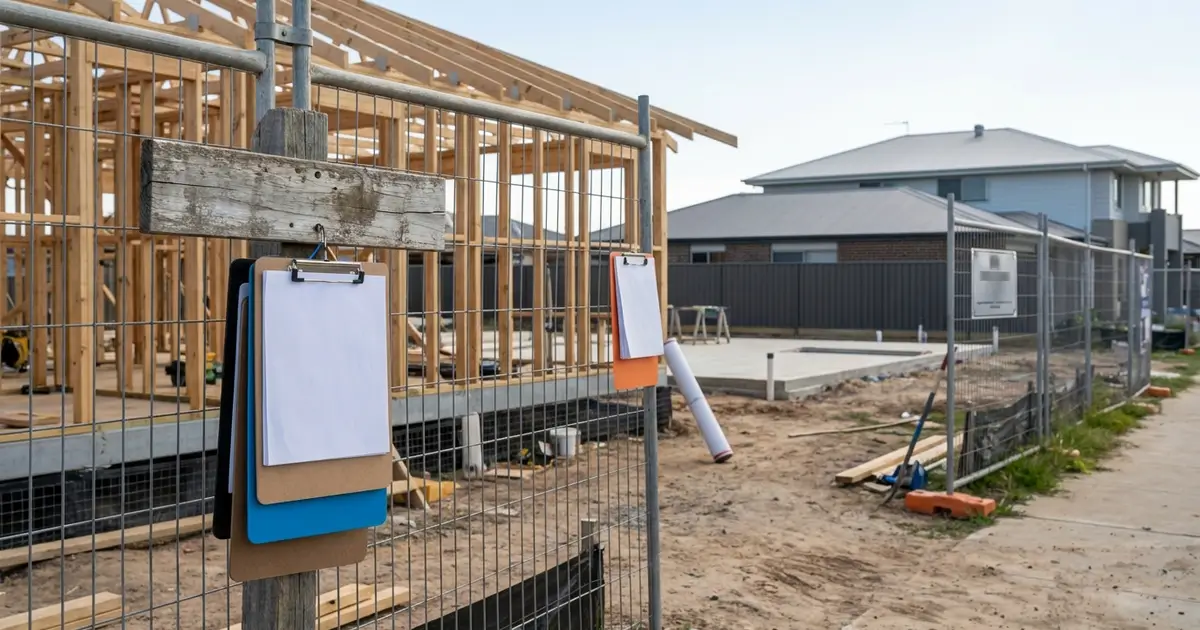
Short answer: an owner-builder permit is an eligibility credential, not a building permit. It says you may take responsibility for domestic building work on your own land without holding a builder's licence. You still need a building permit from a building surveyor or certifier, and you carry the supervision, insurance and warranty consequences a licensed builder would otherwise carry. The name differs everywhere — approval in WA, permit in NSW, QLD, TAS and the NT, certificate of consent in Victoria, licence in the ACT — and South Australia runs no stand-alone version at all.
Key Takeaways
- Three things get conflated. The owner-builder credential, the building permit and the insurance position are separate instruments with separate decision-makers.
- The threshold varies by more than double. NSW above $10,000, Queensland above $11,000 including GST, Victoria and WA above $20,000, the NT above $25,000 — each on a differently defined value.
- Every state limits repeat projects — five or six years between credentials, or Tasmania's two Class 1a projects in ten.
- You cannot self-insure your way out. Owner-builder work is excluded from the consumer warranty schemes in NSW, QLD and SA.
- Resale disclosure has its own clock of six to seven and a half years. No national permit register exists.
What an owner-builder permit actually is — and what it is not
The credential authorises a natural person to supervise or carry out domestic building work on land they own or lease without engaging a licensed builder as the responsible party. It is permission to occupy the builder's seat, not a qualification. Three instruments are routinely confused:
- The eligibility credential — WA owner-builder approval (LGIRS), NSW permit (Building Commission NSW), QLD permit (QBCC), VIC certificate of consent (Building and Plumbing Commission, Building Act 1993 s 25E), TAS owner builder permit, ACT owner-builder licence (Construction Occupations (Licensing) Act 2004), NT owner builder certificate. South Australia: no stand-alone equivalent identified on PlanSA or Consumer and Business Services material reviewed here.
- The building permit — a separate approval from a private surveyor or certifier, or council as permit authority, assessing the construction against the National Construction Code. The difference between planning approval and a building permit is a further distinction.
- The insurance and warranty position — the warranties, exclusions and resale disclosures attaching to the work once it exists.
The credential never authorises work outside the described scope, specialist work such as electrical, plumbing, gasfitting or air-conditioning, land you do not own or lawfully lease, or building for someone else. As NSW puts it, an owner-builder permit "is not a building licence".
The four tests most owner-builder schemes share
Ownership. Owner or joint owner, a director of the owning company, or a registered long-term lessee. WA accepts an individual only; NSW a shareholder or three-year lease; the ACT requires the lessee.
Intention to occupy. NSW requires an intention to live there; WA intention to reside and no immediate intention to rent or sell; Victoria to reside or intend to reside. Queensland imposes no equivalent test, which is why its licensing rules become the constraint.
Evidence of knowledge. WA accepts a course or practitioner registration plus a white or blue card; NSW approved education above $20,000 plus a white card; QLD a course under five years old or an exemption; VIC eLearning plus construction induction; the ACT a course within five years or a Class A, B or C licence.
A separate building approval. In WA the credential precedes the permit and expires six months after issue if unused. In NSW you need it before appointing a principal certifier. In the ACT the order reverses: an active approval is an eligibility condition of the licence.
State-by-state owner-builder requirements
A starting map, not a legal opinion. Fees and thresholds move on 1 July in most jurisdictions, and each threshold uses a different value definition — market cost in NSW, trade price in QLD.
| Jurisdiction | Instrument | Issuer | Trigger | Knowledge requirement | Repeat limit |
|---|---|---|---|---|---|
| WA | Owner-builder approval | LGIRS | Over $20,000; $50,000 Class 10a | Course or practitioner registration, plus white/blue card | 6 years from building permit |
| NSW | Owner-builder permit | Building Commission NSW | Over $10,000 | White card; education above $20,000 | Special circumstances within 5 years |
| QLD | Owner-builder permit | QBCC | Over $11,000 incl GST | Course ≤5 years, or exemption | 6 years, with exemptions |
| VIC | Certificate of consent | Building and Plumbing Commission | Over $20,000 | eLearning plus construction induction | 5 years, different property |
| SA | No stand-alone permit identified | — | Building consent within development approval | — | Building Work Contractors Act 1995 licensing instead |
| TAS | Owner builder permit | Consumer Affairs Tasmania | Residential permit work | Course within 12 months; white card; $5m public liability | Two Class 1a projects in 10 years |
| ACT | Owner-builder licence | Access Canberra | Class 1, 2 or 10a main home | Course within 5 years or Class A/B/C licence; active building approval | 5 years, different land |
| NT | Owner builder certificate | Building Practitioners Board | Over $25,000 | Owner builder manual declaration | 6 years; one at a time |
Western Australia. Approval precedes the permit, takes about six to eight weeks and costs $212.00 residential on the schedule's 2025-26 column. It expires six months after issue if unused.
New South Wales. Above $10,000 where you are not contracting a licensed builder to supervise. The fee is $233 for 2026-27, with assessment up to three business days, tied to an approved DA or CDC.
Queensland. Above $11,000 including GST; the fee is $493.59 for 2026-27. Queensland is clearest on exclusions: no plumbing, draining, gasfitting or pest control without the occupational licence; no fire protection or mechanical services above $1,100; no removal of more than 10 square metres of asbestos; no multiple dwellings or commercial work.
Victoria. Required above $20,000, assessed against s 25E at $242.40, with processing around 45 business days. Demolition, re-stumping and relocation are outside scope.
Tasmania, the ACT and the Northern Territory. Tasmania requires a building surveyor before applying, a white card, $5 million public liability cover, and for a residence an approved course within 12 months; the Class 1a fee is $470.40. CBOS became Consumer Affairs Tasmania and Building Standards Tasmania on 1 October 2026. The ACT's licence requires an active building approval first. The NT certificate runs three years, needs a fidelity fund certificate, and is not a permit.
South Australia
South Australia does not appear to run a stand-alone owner-builder permit. The approval is building consent within a development approval under the Planning, Development and Infrastructure Act 2016, assessed through PlanSA. The Building Work Contractors Act 1995 licensing regime replaces the eligibility gate.
How to apply, step by step
Most delay comes from title, signatures and course evidence, not assessment.
- Confirm the instrument and whether you cross the threshold, valued the way that state values it.
- Assemble the evidence — identity, title or registered lease, white card, course or exemption, plans, and the approved DA or CDC.
- Get every owner to sign. This is the most common failure; NSW notes rates notice names must match the title.
- Lodge and pay through the state channel — Service NSW, QBCC, VBA360, LGIRS, Service Tasmania or the NT Board.
- Lodge the building permit with the surveyor or certifier — a second application, set out in the documents checklist.
What it costs
There is no national owner-builder fee. The budget has four parts: the credential, the course, the building permit and the insurance or warranty cost at resale.
Fees checked 23 October 2026: NSW $233, QLD $493.59, VIC $242.40, WA $212.00 residential, TAS $470.40 for Class 1a. Course prices are set by providers, not regulators.
GST treatment differs by source. WA states fees are exclusive of GST; the Queensland threshold is defined including GST. Fees and thresholds are not directly comparable across states. Total approval-pathway cost is covered in building permit cost.
Your obligations once you are the owner-builder
You are treated as the builder. NSW states it plainly: you are responsible for the work just as a licensed builder would be — supervising trades, ordering materials, managing the site, obtaining approvals, meeting insurance requirements, providing a safe workplace under WHS law, and warranting the work is fit for purpose.
Engaging a project manager does not remove any of it, as the Northern Territory says. Specialist work cannot be done under the permit, you carry defect liability, and a purchaser pursues you years later. Checking a trade's licence and insurance is covered in licensed and insured trade quotes for Adelaide developers.
Insurance: the gap that catches owner-builders
Owner-builder work is deliberately excluded from the schemes protecting buyers of builder-built homes.
New South Wales. Home building compensation cover is unavailable for owner-builder work (Home Building Act 1989 s 95(1)). Each licensed contractor contracting directly with you must provide cover where the price exceeds $20,000 including materials, before work starts or payment.
South Australia. Building indemnity insurance is a contractor obligation under s 34 of the Building Work Contractors Act 1995. Since 10 November 2025 the threshold is $20,000 (up from $12,000) and the limit $250,000, per the South Australian Government Financing Authority. Critically, you cannot take it out if you do the work yourself. Queensland excludes owner-builders from the Home Warranty Scheme; WA and Victoria bind at resale.
Selling an owner-built home
Every state attaches a disclosure, insurance or warranty consequence with its own clock.
| State | What must happen | Period |
|---|---|---|
| NSW | Consumer warning in the contract (Home Building Act 1989 s 95(2)); voidable if omitted | 7 years 6 months from permit |
| QLD | Written notice before signing, including the warning that the work is not covered by QBCC insurance | 6 years from completion |
| VIC | Domestic building insurance and home warranty; notice of cover and defects report in the s 32 statement | 6 years 6 months from occupancy permit |
| WA | Home indemnity insurance covering the purchaser and later owners | 7 years from building permit |
| SA | Disclose whether indemnity insurance is in place; BII unavailable on self-built work | — |
The obligations run with the land: NSW applies the warning to a successor in title, and Victoria's warranties extend to later owners and cannot be excluded by the sale contract. They are enforced — a WA owner-builder was fined $1,800 in 2025 for selling without home indemnity insurance.
Build-to-sell is a different business
WA is explicit that if you intend to develop for immediate sale, the owner-builder pathway is not appropriate. In South Australia the constraint is sharper: the Building Work Contractors Act 1995 reaches a person carrying on the business of building work with a view to the sale or letting of the improved land, and presumes repeated selling or letting means carrying on that business unless proved otherwise.
GST, tax and the build-to-sell question
GST and income tax treatment depends on whether you carry on an enterprise and supply new residential premises — not on whether you hold an owner-builder permit. This is not tax or legal advice: if the plan is build-and-sell, put the question to a tax agent and solicitor before lodging.
Check an owner-builder permit before you rely on it
There is no national register; verification is state by state.
- Victoria publishes a public register of certificates of consent issued since 1 September 2016.
- New South Wales lets you check a permit issued in the last 10 years by name or licence number.
- Queensland publishes QBCC registers, and flags the permit on the title for seven years.
- Western Australia publishes an LGIRS licence search; South Australia the CBS licensing register, which covers contractors and trades rather than owner-builders.
Check the name, property and scope match, the dates are current and the status is not cancelled. A permit says nothing about competence. For the property record, the building permit search guide covers address-level lookups, and planning map viewers by state shows the zoning behind it.
South Australia: building consent, licensing and what CPM does
South Australia is the state most often misdescribed in national roundups. The approval you need is building consent within a development approval, assessed through PlanSA under the Planning, Development and Infrastructure Act 2016. What sits in front of it is whether you are performing regulated building work at all — which the Building Work Contractors Act 1995 reads wider than "builder".
Cyberate Project Management (CPM) is part of DDDI Group, which publishes this article. Links to CPM are related-party referrals, not independent recommendations. CPM provides development approval and subdivision management in South Australia only; approval rules, fees and services differ in other states.
CPM has written up the licensing and build-to-sell analysis in Do I need a builder's licence to build and sell in SA?. CPM does not act as builder, certifier, consent authority or insurer.
For a South Australian owner-builder project, book a free consultation with CPM to work through the approval pathway and licensing question before lodging.
When owner-building is the wrong tool
It is the wrong choice where you cannot be on site most days; where your lender requires a licensed builder; where the design is complex or the site constrained; where you intend to sell inside the disclosure window; or where you will not carry defect liability for years. The national guide to building permit applications sets out the approval sequence, and do you need a building permit covers thresholds below which none of this applies.
Frequently Asked Questions
Is an owner-builder permit the same as a building permit?
No. The owner-builder permit is an eligibility credential that lets you take the builder's role on your own land. The building permit is a separate construction approval issued by a surveyor, certifier or council against the National Construction Code. You need both, from different bodies.
Do I need an owner-builder permit to build my own home?
It depends on the state and the value. New South Wales applies above $10,000, Queensland above $11,000 including GST, Victoria and Western Australia above $20,000, the Northern Territory above $25,000. Victoria also exempts work where a registered practitioner is nominated as responsible.
Can I sell a house I built as an owner-builder?
Yes, subject to a disclosure or insurance obligation with its own clock. New South Wales requires a consumer warning within 7 years 6 months of the permit; Queensland a written notice within 6 years; Victoria insurance and home warranty within 6 years 6 months; Western Australia home indemnity insurance within 7 years of the building permit.
Do owner-builders need insurance?
Not the consumer warranty cover — you cannot get it for your own work. New South Wales excludes owner-builder work from home building compensation, South Australia bars the person doing the work from taking out building indemnity insurance, and Queensland excludes owner-builders from the Home Warranty Scheme. You still need public liability, contract works and workers compensation cover.
How long does an owner-builder permit take?
Western Australia states about six to eight weeks, Victoria approximately 45 business days, and New South Wales up to three. Delays usually come from incomplete documents rather than the assessment.
Sources and verification
Every threshold, fee and period above was read from the page cited, retrieved 23 October 2026. Fees and limits move on 1 July in most jurisdictions and each threshold uses a different value definition, so confirm at application.
| Claim | Source | Retrieved |
|---|---|---|
| WA: approval required before a building permit; $20,000 threshold, $50,000 Class 10a; 6–8 weeks; expires 6 months unused; six-year limit runs from building permit | WA — Owner-builder approval | 2026-10-23 |
| WA: residential approval fee $212.00 (2025-26 schedule) | WA Building and Energy — Fees | 2026-10-23 |
| NSW: permit above $10,000; education above $20,000; white card; tied to an approved DA or CDC; up to 3 business days | Service NSW — Owner-builder permit | 2026-10-23 |
| NSW: permit fee $233 (2026-27) | Building Commission NSW — Fees | 2026-10-23 |
| NSW: permit is not a building licence; specialist work excluded; HBC unavailable for owner-builder work; contract warning applies to resale | Home Building Act 1989 (NSW) s 95 | 2026-10-23 |
| QLD: permit above $11,000 incl GST, $27,500 farm buildings; course within 5 years; six-year limit with exemptions; exclusions list | QBCC — About owner-building | 2026-10-23 |
| QLD: permit fee $493.59 (effective 1 July 2026 – 30 June 2027). QBCC's public fee page still shows the prior-year $477.47, last reviewed 1 July 2025; the current application form governs | QBCC — Owner-Builder permit application form | 2026-10-23 |
| QLD: disclosure of owner-built work on resale within 6 years; title advice 7 years | QBCC — Selling an owner-builder property | 2026-10-23 |
| VIC: certificate of consent under s 25E; $20,000 threshold; five-year limit for a different property; demolition and relocation excluded | BPC — Owner-builders | 2026-10-23 |
| VIC: fee $242.40; approximately 45 business days | BPC — Applying for a certificate of consent | 2026-10-23 |
| VIC: domestic building insurance and warranties within 6 years 6 months, extending to subsequent owners | BPC — Selling an owner-built home | 2026-10-23 |
| SA: no stand-alone owner-builder permit identified; building consent sits inside a development approval; Building Work Contractors Act 1995 licensing applies | PlanSA — Building; CBS — Licensing | 2026-10-23 |
| SA: building indemnity insurance threshold $20,000 from 10 Nov 2025, limit $250,000; the person doing the work cannot take it out | SA.GOV.AU — Building indemnity insurance | 2026-10-23 |
| TAS: white card; $5m public liability; course within 12 months; building surveyor engaged first; two Class 1a projects in 10 years | Service Tasmania — Apply for an owner builder permit | 2026-10-23 |
| TAS: fees $470.40 Class 1a, $235.20 Class 10a/10b/8 (2026-27); CBOS became Consumer Affairs Tasmania and Building Standards Tasmania on 1 Oct 2026 | Building Standards Tasmania | 2026-10-23 |
| ACT: owner-builder licence; course within 5 years or Class A/B/C licence; active building approval; individual lessee only; five-year limit on different land | ACT Planning — Construction licences | 2026-10-23 |
| NT: certificate above $25,000; three years renewable once; six-year wait; fidelity fund certificate; not a building permit | NT.GOV.AU — Owner builder certificate | 2026-10-23 |
The frame worth keeping
Separate the three instruments, because they run on different clocks and decision-makers. Check the threshold in the state where the land is. Then price the resale consequence at the start: it outlasts the build and cannot be insured away.