
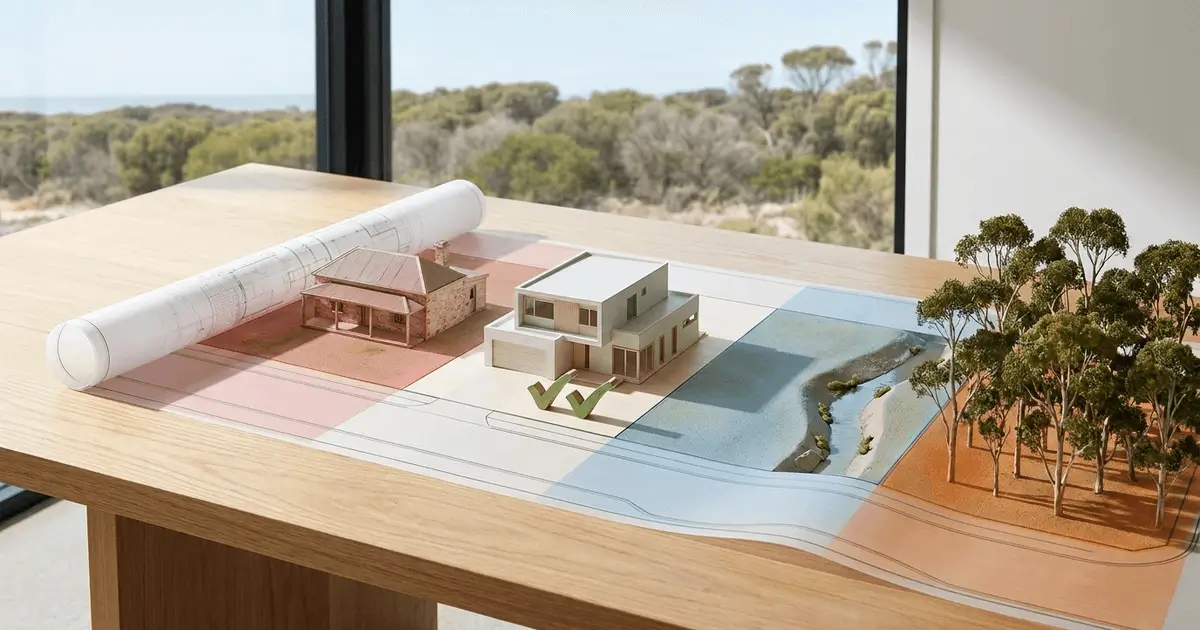
Finding out what zone a property sits in takes about thirty seconds on the NSW Planning Portal Spatial Viewer. Finding out whether that same property can be approved by a private certifier in three weeks — rather than through a council Development Application that runs for months — takes longer, and it is what decides the project's program and holding costs.
Complying development is a two-gate test, and the gates must be cleared in order. Gate one asks whether the land is capable of complying development at all. Gate two asks whether the design meets every applicable standard. Most failed fast-track applications fail at the first gate, for a reason that was visible on the Spatial Viewer before a single drawing was commissioned.
This guide is that eligibility screen, working through the land-based exclusions in the State Environmental Planning Policy (Exempt and Complying Development Codes) 2008 — the Codes SEPP. For the mechanics of the Viewer itself, see our ePlanning Spatial Viewer Guide.
Key Takeaways
- Eligibility is two gates, cleared in order: whether the land can use the Codes SEPP, then whether the design meets every standard. A Code-perfect design on an excluded lot still goes to council.
- The exclusions are consolidated in a few clauses: clauses 1.17A, 1.18, 1.19 and 1.19A of the Codes SEPP, plus the local maps listed in Schedule 5.
- Bush fire prone land is not automatically excluded: the statutory bar is BAL-40 and BAL-FZ (flame zone) under clause 1.19A. At BAL-29 or lower the Code remains available, with added standards and a BAL certificate.
- Heritage is the most complete disqualifier: heritage items, draft heritage items and land in a heritage conservation area are broadly excluded, and demolition of a dwelling in a conservation area is not available under the Codes SEPP.
- Certifiers have no discretion: under section 4.28(7) of the Environmental Planning and Assessment Act 1979, a certifier must not refuse a CDC where the development complies — and cannot issue one where any standard fails.
- The determination clock is 20 days where pre-approval neighbour notice applies, otherwise 10 days; the Pattern Book pathway is 10 days (EP&A Regulation 2021, section 133).
Two Gates, Cleared in Order
A Complying Development Certificate (CDC) is a combined planning and construction approval, replacing both the development consent and the separate construction certificate a DA would require. It can be issued by the local council or a registered certifier, who hold identical legal authority under the Act.
Critically, complying development does not create permissibility. It fast-tracks a use the local environmental plan already permits with consent. If the LEP prohibits the use, no amount of Code compliance produces a CDC. If you have not established what your zone permits, start with our guide on how to check zoning in NSW.
The two gates fail differently, which is why the order matters.
Gate 1 — land eligibility. Failing this generally cannot be designed around. No setback change, reduced footprint or material substitution fixes a heritage item or a BAL-FZ rating. The project goes to council as a DA, or does not proceed.
Gate 2 — design compliance. Failing this is often recoverable. A setback that misses by 200 millimetres, a ridge that barely exceeds the limit, a landscaped area that falls short — design problems with design solutions.
Screen Gate 1 before spending money on drawings. If the lot is excluded, the documentation set, the consultant list and the program all change.
Gate 1: Screening the Land on the Spatial Viewer
Each step below corresponds to a land-based exclusion and can be checked on the Spatial Viewer before you brief a designer.
Step 1: Confirm the zone and permissibility
Complying development requires that the proposed use is permitted with consent. This is the threshold step, and the only one where a failure sometimes has an alternative answer: where the design cannot fit the Code, the Low and Mid-Rise Housing reforms create height and density opportunities in defined catchments around transport and centres. Check whether your parcel falls inside one in our guide to the NSW Low and Mid-Rise Housing Map.
Step 2: Switch on the bush fire prone land layer
Read two things separately. The layer shows vegetation categories with buffers — 100 metres for Category 1, 30 metres for Categories 2 and 3. These are mapping inputs, not Bushfire Attack Level ratings. The rating that decides your pathway is a separate, site-specific calculation under AS 3959.
The statutory bar is narrower than most people assume. Clause 1.19A excludes complying development only on land rated BAL-40 or BAL-FZ (flame zone). At BAL-29 or lower the Codes SEPP remains available, subject to additional bushfire standards and a BAL Certificate confirming the rating. A BAL-29 site can still be a CDC; a BAL-40 site cannot. For what the scale means physically, see our guide to bushfire, flood and heritage maps in NSW.
Step 3: Check flood planning and flood control lot status
Flood is where the Viewer stops being sufficient alone. It shows the flood planning area — an extent. What governs your project is the flood control lot designation, determined by the council and stated authoritatively on a section 10.7 planning certificate.
- High risk and high hazard flood control lots cannot use the complying development pathway at all. A DA is required.
- Lower-risk flood control lots can use the Code, but only where the dedicated flood standards are met — addressing floor levels, flood storage, compensatory excavation and, for sensitive uses, evacuation.
Step 4: Check heritage — items, draft items and conservation areas
State heritage items are listed on the State Heritage Register under the Heritage Act 1977, with works generally requiring approval under section 60 from the Heritage Council. Local heritage items sit in the council's LEP heritage schedule, alongside heritage conservation areas. For complying development purposes the exclusions are broad:
- Heritage items and draft heritage items are excluded from the pathway.
- Land within a heritage conservation area is excluded under several of the Codes SEPP housing codes.
- Demolition of a heritage item, a draft heritage item, or a dwelling within a heritage conservation area is not available under the Codes SEPP at all.
The trap is the conservation area boundary. An HCA applies to every property inside it, whether or not the individual dwelling is identified as a heritage item. Owners who check only their own listing status then discover a rear extension that would be exempt development on an ordinary suburban lot requires a full DA and a Heritage Impact Statement.
Step 5: Check biodiversity, environmentally sensitive land and coastal layers
Complying development is excluded on land that is a declared area of outstanding biodiversity value or critical habitat, land identified as an environmentally sensitive area, coastal vulnerability areas and coastal erosion hazard land, and land subject to Class 1 or 2 acid sulfate soils — though here the exclusion is narrower than most assume, applying to the parts of the lot so classified rather than necessarily the whole lot.
Step 6: Check Schedule 5 local maps and unsewered land
Schedule 5 lists maps by local government area identifying specific land where complying development is prohibited. It is the local layer on top of the statewide exclusions and the step practitioners most often skip — the answer is not on the standard constraint layers, because it comes from a council-specific map. Some former exclusions have sunset: the City of Sydney maps ceased to have effect on 31 December 2022, and the Mosman maps on 30 November 2023.
Separately, unsewered land within a drinking water catchment is excluded for certain codes where the development would increase the number of bedrooms or disturb more than 250 square metres.
Step 7: Confirm the lot can physically meet the standards
Check the thresholds the Code imposes on the lot itself — most commonly minimum lot size and frontage for the development type, and lawful access to a public road. A lot that fails these cannot use the Code regardless of the design. For the dual occupancy and duplex, the specific thresholds are set out in our guide to the dual occupancy site check for NSW.
Gate 2: Why the Certifier Has No Discretion
Once the land clears Gate 1, the remaining test is purely mechanical. A certifier does not assess whether a proposal is reasonable, appropriate or sympathetic to the streetscape. There is no merit assessment, no design judgement, no weighing of neighbour objections — only a check of the applicable development standards, one by one.
The Act makes the result mandatory in both directions. Under section 4.28(7) of the Environmental Planning and Assessment Act 1979, a council or registered certifier must not refuse to issue a complying development certificate if the proposed development complies with the applicable development standards. The mirror image is equally absolute: if any applicable standard is not met, the certificate cannot lawfully be issued.
This is the trade the Codes SEPP makes. You exchange discretion for certainty and speed, and accept that "almost compliant" has no legal meaning. There is no partial CDC, no conditioning away of a non-compliance, no negotiation. Where a design fails narrowly the productive response is to design back into compliance — reduce the floor area, shift the setback, lower the ridge, drop a storey. Where the failure is structural, the project converts to a development application.
CDC vs DA: What Changes When You Lose the Fast Track
| Complying Development (CDC) | Development Application (DA) | |
|---|---|---|
| Decision-maker | Council or registered certifier | Council (or relevant consent authority) |
| Assessment basis | Objective compliance with published standards | Merit assessment against EP&A Act s 4.15 matters |
| Discretion | None | Substantial |
| Determination period | 20 days with pre-approval neighbour notice, otherwise 10 days; 10 days for Pattern Book | No fixed statutory period; averages materially longer |
| Neighbour objection rights | None — notification is advisory only | Submissions and, in some cases, review rights |
| Approval scope | Combined planning and construction approval | Consent only; separate construction certificate required |
| Applicant merits appeal | Not available | Available to the Land and Environment Court |
Two timing details are commonly quoted incorrectly. The 20-day period applies where the application requires pre-approval neighbour notice — for new dwellings, additions and demolition on a lot within 20 metres of another dwelling, outside residential release areas. Where notice is not required, the period is 10 days. The Pattern Book pathway has its own 10-day period with a shorter 7-day notification window (EP&A Regulation 2021, section 133).
Notification is advisory, not participatory. Neighbours receive notice 14 days before the certificate is granted where the requirement applies, and the applicant must give at least 7 days' notice before commencing work — but neighbours cannot lodge an objection that stops the certificate.
The authoritative site answer, for either pathway, is a section 10.7 planning certificate, which states whether complying development may be carried out under each code and, where it may not, the specific reason.
Frequently Asked Questions (FAQ)
What is the difference between complying development and a DA in NSW?
A CDC is issued by a council or registered certifier against fixed, published development standards, with no merit assessment and no discretion. A DA is assessed by the council on its merits against the matters in section 4.15 of the Environmental Planning and Assessment Act 1979. Complying development is faster and more certain; a DA is more flexible.
Does being on the bush fire prone land map stop me getting a CDC?
Not by itself. That map shows vegetation categories and buffers, not Bushfire Attack Levels. Under clause 1.19A of the Codes SEPP, complying development is excluded only on land rated BAL-40 or BAL-FZ (flame zone), certified under AS 3959. At BAL-29 or lower the pathway remains open, subject to additional bushfire standards and a BAL Certificate.
Can I get a CDC on a flood control lot?
Only if the lot is not high risk or high hazard, and only if the development meets the specific flood control standards in the Codes SEPP — floor levels, flood storage, compensatory excavation and, for sensitive uses, evacuation. High risk and high hazard lots cannot use the pathway at all. Because flood control lot status is a council determination rather than something fully visible on the map, confirm it on a section 10.7 planning certificate.
Can I use complying development on a heritage-listed property or in a heritage conservation area?
Generally, no. Heritage items and draft heritage items are broadly excluded, and land within a heritage conservation area is excluded under several of the Codes SEPP housing codes. Demolition of a heritage item or of a dwelling within a conservation area is not available under the Codes SEPP at all. A small number of low-impact works are permitted in certain conservation area circumstances, but the default position is a development application.
How long does a complying development certificate take to be determined?
Under section 133 of the Environmental Planning and Assessment Regulation 2021, a CDC application must be determined within 20 days where pre-approval notice to neighbours is required, and 10 days in any other case. Applications under the Pattern Book Development Code 2025 are determined within 10 days. The clock runs from a complete application, and a certifier may stop it by requesting further information.
If my design fails one standard, can the certifier still issue a CDC?
No. Section 4.28(7) of the Environmental Planning and Assessment Act 1979 prohibits a certifier from refusing a CDC where the development complies — and the converse is equally absolute. There is no discretion to waive or condition away a non-compliance. If a single applicable standard is not met, the CDC pathway is unavailable, and the options are to amend the design back into compliance or lodge a development application.