
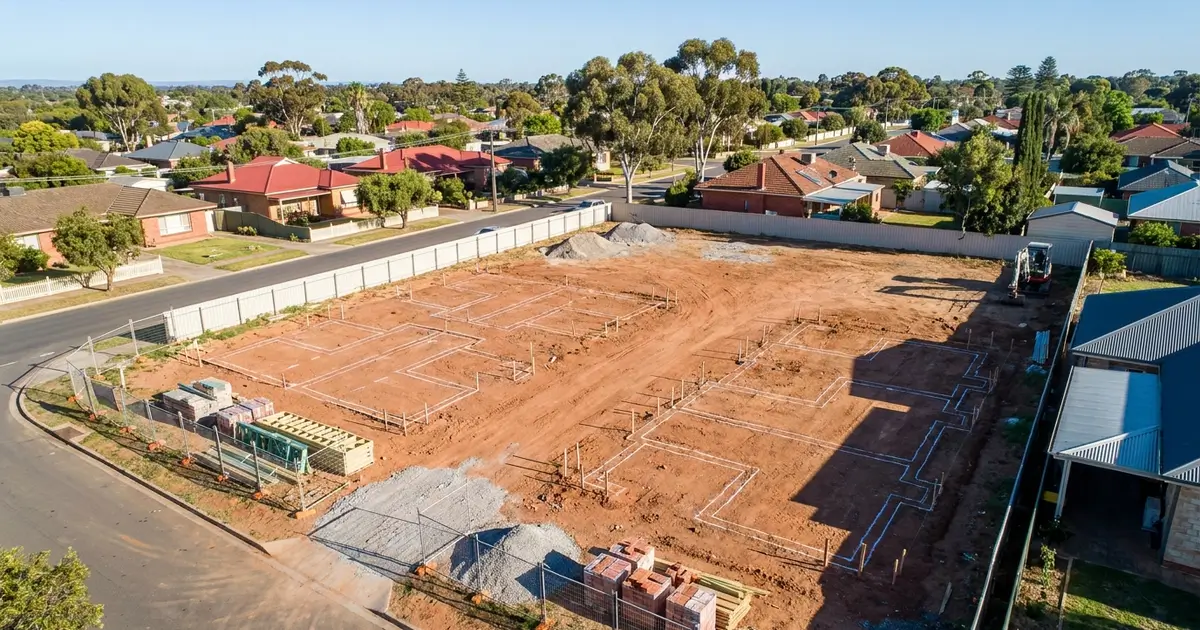
On a small infill site, the product type is a financial decision before it is an architectural one. The same block can carry a duplex, a dual occupancy on separate titles, or three or four townhouses, and each version returns a different margin from a different cost structure.
This guide works through those differences at the level where the answer is actually decided: the model. Planning eligibility is assumed to be settled here, because it is a separate question with its own arithmetic. If you need the NSW duplex eligibility checks, our dual occupancy site check covers zoning, minimum area, frontage and the complying development pathway. For South Australian zoning, start with how to use SAPPA to check zoning in Adelaide. This page picks up once the site is assumed to clear.
Key Takeaways
- Product type changes your cost structure, not just your dwelling count. Some costs scale with each dwelling; some are fixed per site; some jump at a threshold.
- Per-dwelling construction cost is broadly similar across the three types. The divergence accumulates in the shared and fixed lines, and in how many times you multiply the per-dwelling stack.
- Title structure is a model input, not a legal footnote. Torrens and strata title change the subdivision cost line and what each finished dwelling can sell for, at the same time.
- Changing a product assumption means re-reconciling the whole model. A yield change with an unchanged cost stack is not a feasibility, it is a wish.
Why Product Type Is a Financial Decision
A site that can carry two dwellings can often carry three. Choosing the denser scheme usually raises gross realisation value, and it raises cost at the same time. Choosing the less dense scheme lowers both.
So the question is not "what fits on the block". It is "which version returns the best risk-adjusted margin once every cost is counted, including the ones that do not care how many dwellings you build".
Planning tells you the ceiling on dwellings. Feasibility tells you whether reaching that ceiling pays. Those are different questions, answered by different professionals with different evidence, and it is worth keeping them separate in your own thinking.
The Three Product Types, Priced Differently
The three types are not three versions of one model. They are three cost shapes.
Duplex and dual occupancy: two dwellings, one land cost
A duplex is two dwellings on one parent lot, attached or detached. Two dwellings share a single land purchase. That concentrates the land cost into a smaller revenue base. In an attached configuration they also share a party wall, which can trim the build itself.
Two dwellings is also the toughest test of the fixed cost stack. Demolition, the driveway, service connections, retaining, stormwater and subdivision are all carried by the first dwellings on the site, and there are only two of them to absorb that load.
Location aside, the scheme can exit three ways at the same build cost: two Torrens titles, two strata lots, or one title held as two rental incomes. That is a revenue decision, not a construction one, and it belongs in the model from the start. Our guide to feasibility versus valuation explains why a feasibility and a bank valuation can legitimately differ on the same scheme.
Townhouse: three or more, with shared infrastructure added
A townhouse scheme multiplies the per-dwelling stack. It also adds shared cost that a two-dwelling development may avoid entirely: a common driveway, shared services, and in many configurations common property that a strata plan has to manage.
It also tends to move the scheme onto a different approval and classification footing, which changes both the fee base and the programme. Programme length is a cost in its own right, since holding costs and interest accrue monthly; our guide to South Australian development approval timeframes covers what drives that clock.
The lever here is not the headline build rate. Per-dwelling construction is broadly similar between a duplex and a townhouse. The differences accumulate in the fixed and shared lines, and in the number of times you multiply everything else.
Modelling Points That Decide the Answer
Dwelling count and mix
More dwellings raise gross realisation value. Cost rises faster at the margin, once shared infrastructure, contributions and the extra professional scope are added. Bedroom count and dwelling size move the sale price per dwelling, so a change of mix changes revenue even at a constant total floor area. Price the scheme dwelling by dwelling, not by floor area alone.
Comparable sales in layers
Price new dwellings from comparable sales of new product of the same type and size, not from a suburb median, which mostly reflects older housing stock. A new-build premium is a claim that needs evidence from actual new sales. Where that evidence is thin, the honest move is to hold the premium out of the base case and test it as an upside scenario.
The fixed-versus-per-dwelling split
This is the split that actually decides which product type wins. Construction scales with each dwelling. So does per-dwelling selling cost. Demolition, the common driveway, subdivision and approval fees are largely fixed per site. A three-dwelling scheme spreads those fixed costs across three revenue units; a two-dwelling scheme spreads them across two.
The consequence is unintuitive and worth stating plainly. On a site with high fixed costs, adding a third dwelling can be worth more than that dwelling's own profit. It dilutes the fixed load the other two are carrying.
Title structure: Torrens versus strata
Torrens title creates separate lots, each with its own boundaries and its own services, and no shared ownership. Strata title creates lot entitlements within one parcel, with common property managed through an owners corporation. A strata plan subdivides fee simple land, as the NSW Registrar General's requirements for a strata plan confirm. The two are not interchangeable in the model, because they change cost and revenue in opposite directions.
Torrens has to deliver a standalone parcel with its own servicing, so the survey, works and registration load sits on the title itself. Strata avoids that by keeping the parcel whole and defining entitlements within it, but it brings common property, an owners corporation and ongoing levies into the product you are selling. Which one returns more depends on the local market and on what each finished dwelling can actually be sold for. Price both structures against your own comparable sales rather than assuming a direction, and model both lines, not just the subdivision fee.
Services, earthworks and site conditions
Demolition, service connections, retaining walls, stormwater and any tree or easement constraint are largely fixed costs. On a two-dwelling scheme they are spread across two dwellings, so they weigh more heavily per dwelling than they would on a larger project. A constrained parcel reduces the developable ground before design even starts, which is why these constraints belong in the cost model rather than being discovered at documentation stage.
Worked Example: Comparing the Same Small Site
The figures below are an illustrative example for a small South Australian infill site, not real project data. All amounts are GST-exclusive.
Base case: three dwellings.
| Item | Amount |
|---|---|
| Gross realisation value (GRV) | $3,000,000 |
| less construction (incl. contingency) | −$1,500,000 |
| less professional fees | −$120,000 |
| less statutory charges and contributions | −$80,000 |
| less finance and holding costs | −$150,000 |
| less selling and marketing | −$150,000 |
| Non-land development costs | $2,000,000 |
| less target profit | −$400,000 |
| Residual land value (ceiling) | $600,000 |
At a land price of $600,000 the arithmetic closes: total development cost is $2,600,000, profit is $400,000, margin on cost is 15.38% and margin on revenue is 13.33%.
Now split the cost stack into the part that is fixed per site and the part that scales with each dwelling. The split below reconstructs the $2,000,000 base exactly.
| Cost line | Fixed per site | Per dwelling |
|---|---|---|
| Construction (incl. contingency) | n/a | $500,000 |
| Professional fees | $60,000 | $20,000 |
| Statutory charges and contributions | $20,000 | $20,000 |
| Finance and holding | $60,000 | $30,000 |
| Selling and marketing | $30,000 | $40,000 |
| Total | $170,000 | $110,000 |
Two-dwelling variant: what actually changes. Assume the second dwelling is removed and one dwelling's price is removed from revenue. Per-dwelling construction and per-dwelling soft costs fall with it. The land price, the fixed per-site costs and the per-dwelling sale price are all held unchanged.
| Item | Three dwellings | Two dwellings |
|---|---|---|
| Gross realisation value | $3,000,000 | $2,000,000 |
| Non-land development costs | $2,000,000 | $1,390,000 |
| Land (held at) | $600,000 | $600,000 |
| Total development cost | $2,600,000 | $1,990,000 |
| Profit | $400,000 | $10,000 |
| Margin on cost | 15.38% | 0.50% |
Nothing about the two-dwelling scheme is worse per dwelling. It is the same build spec and the same sale price. The margin collapses because $170,000 of fixed cost is now shared by two revenue units instead of three. To restore a 15.38% margin on cost at the same land price, each of the two dwellings would need to sell for roughly $1,148,000, a premium of about 15% over the $1,000,000 used here. That is the real question a duplex-versus-townhouse comparison has to answer: can this location support that premium on a two-dwelling product? If it can, the duplex is a cleaner, lower-capital project. If it cannot, density is carrying the deal.
Two cautions on the mechanics. First, transfer duty, land-related interest and the GST margin scheme can each depend on the land price. In a real model the land price and those cost lines are therefore mutually dependent, and have to be solved iteratively: two or three passes, or Goal Seek. The subtraction above is a screening simplification, not a general exact solution. Second, the GST margin scheme is a tax calculation basis, not a measure of development profit; the ATO sets out how the margin is calculated as sale price less the price paid for the land.
When Assumptions Move
Sensitivity testing is not a probability forecast. It is scenario testing, and each variable should be moved separately before you combine them. The cluster's shared test set is: sale price ±8%, construction +10%, interest rate +2 percentage points, and programme extended by three months. Our guide to development feasibility sensitivity analysis covers how to run those tests properly.
The small-site consequence of the earlier arithmetic is straightforward. Fixed-cost concentration means a construction overrun bites harder on a two-dwelling scheme than on a three-dwelling one, because there are fewer dwellings to absorb it. A $150,000 overrun is $75,000 per dwelling across two, and $50,000 per dwelling across three. That is the same risk, unevenly distributed by product choice. For the full cost line-up, see property development costs.
A Group Case: Five Townhouses on a Constrained Parcel
Cyberate PM, part of the DDDI Group, publishes a case about a parcel sliced apart by protected trees and a service easement. It was developed as five townhouses, and all five were approved. The publicly stated detail is the constraint set and the approval outcome. The group has not published the site area, sale prices, profit or programme for that project, and none should be inferred from it.
The feasibility lesson is in the constraint set itself. A parcel fragmented by exclusion zones has less developable ground than its title area suggests, and that reduction flows straight into dwelling yield and build cost before a single drawing is produced. Modelling the constraints onto one plan early is a cost decision.
If you are testing a constrained site of your own, Cyberate PM's development feasibility service, delivered by a DDDI Group affiliate, sets out how that three-way test is structured.
Frequently Asked Questions
Is a duplex or a townhouse development more profitable?
Neither in the abstract. A duplex concentrates the land cost and the fixed cost stack into two revenue units. A townhouse scheme dilutes the fixed stack across more units, but adds shared infrastructure and a larger absolute capital requirement. The answer depends on how much of the fixed load the site carries and whether the two-dwelling product can command enough of a price premium to justify carrying it. Run both versions of the same model before choosing.
Does Torrens or strata title make more money?
It changes both sides of the model, which is why it has to be tested rather than assumed. Torrens title has to produce standalone lots with their own servicing; strata title keeps the parcel whole and defines entitlements within it, but brings common property and ongoing levies into the product. Which one wins depends on what each finished dwelling can be sold for in your location, so there is no automatic answer.
Do I need a feasibility before I know my planning outcome?
In a preliminary form, yes. A financial screen prices the range of yields the planning system might allow, which tells you which planning outcome is worth pursuing and what site price the best of them can support. That screen is not a substitute for confirmed eligibility; it is what tells you which eligibility outcome actually matters. The model is then rerun once eligibility is settled.
Where to Go Next
The product-type decision is a cost-structure decision, not a dwelling-count decision. Every time you change a yield, a mix or a title structure, re-reconcile revenue, cost, profit and margin together, and re-run the residual land value so the land ceiling moves with them.
For the full method behind these numbers, including the formula, the cost stack and a complete worked example, start with our pillar guide to property development feasibility.